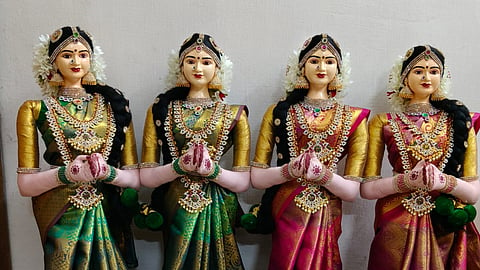

The needle punched the fabric, taking colourful threads along with it while carving designs and stories. This process is orchestrated by two hands that work in tandem, with loose skin showing signs of ageing along with experience, wisdom, and perspective. The practitioner is Nisha Srikanth’s grandmother. As she wove fabrics together and made dolls, Nisha used to observe the pattern and play with them. The skill took root in her, and she kept up the legacy by making fabric dolls even after getting married, moving to Chennai, and managing a high-profile job for almost 35 years. “My grandmother used to make fabric dolls, one of the oldest forms of doll-making. I would sit with her during Navaratri, decorating them, making thematic dolls, and then, when the festival ended, they became my toys,” Nisha recalls.
Cut to 2017, Nisha’s childhood fascination with dolls left a spark at a family wedding. Instead of the usual fruit and vegetable arrangements at the reception, Nisha and her sister decided to try something new. “We made dolls that represented the rituals of a wedding — everything from the wearing toe ring and reason behind ammi mithidal practice to the seven rounds around the fire,” she says.

Over 50 dolls, each with a small write-up, were displayed at the ceremony. It was a huge hit, and the pictures of these dolls made rounds on social media, also catching her boss’s attraction. “While most people think of clay, PoP, or plastic dolls, not everybody’s aware of fabric dolls. Moreover, this is a dying form of an art and it becomes our responsibility to take it to the next generation,” adds Nisha.
Then the sisters decided to hold to thread of memories and build a business out of this craft.
Today, Nisha, founder of Sri Kolhapuri Dolls, runs a small factory in Nanganallur with 12 women. Here, she innovates, produces and sells fabric dolls. “We have a festive calendar and produce dolls based on them. In the 12-month cycle, peak sales are for six months, and in the rest of the months we decide, create and then get into production,” shares Nisha.
She began her entrepreneurial journey with just one tailor by her side and `50,000. “I used to draw one design, make a doll, post it online, and it would get sold immediately. Within six months, I had to hire six more people because I couldn’t handle the orders alone,” she adds.
The number and the kinds of orders were diverse, from brides and classical dancers to deities, but each doll represented a slice of Indian tradition and culture. With base material as cotton and often dressed in Banarasi silks, raw silks, silk cotton, or semi-silk, these dolls are also customised for festivals. “For Varalakshmi puja, we begin work in March because it’s a complicated process. Our calendar is designed around Indian festivals, every month has its own production rhythm. During the Tamil month of Thai, there is a huge production of Murugan dolls, in the Aadi month, it is Ambal, and so on,” she explains.
The brighter side of these dolls, apart from being eco-friendly, is that they have longer shelf life. “The lifespan of these dolls is at least 50 years,” Nisha says, “They are fabric-based, except for the jewels, which also on special requests are made out of lace bits. The best part is that you can change the dress or even convert one doll into different forms. And unlike clay dolls, they don’t break.”
Her creations have caught the eye of thousands, setting new trends or hopping on to the trend bandwagon. During the release of Ponniyin Selvan: II, in 2023, she crafted dolls of Kundavai and other characters. The Varahi dolls became a massive hit. Each year, she experiments with new avatars of Andal and goddesses like Kanchi Kamakshi, Kashi Visalakshi, and Madurai Meenakshi.
The journey hasn’t just been about selling dolls. During Covid, Nisha began online classes, training over 3,000 women in doll-making. “I realised not many people knew about fabric doll-making. I connected with 50-60 women across India, and we formed an association. It’s our responsibility to carry this art legacy forward.”
With a customer base of at least 25,000, and 50,000 on social media, Sri Kolhapuri Dolls has come a long way. The name itself, she says, is a nod to her Maharashtrian roots. “Everyone knows Kolhapuri chappals. I wanted people to know that Kolhapuri dolls are also famous. Today, they reach homes across the world. Around 60% of Ganesha dolls used during Chaturthi in Chennai are from Kolhapur.”
This year, she’s made Amaran movie characters, a thematic set up based on Operation Sindoor for the Golu season. What once started as an observation turned into a determined practice to carry forward stories of our ancestors.