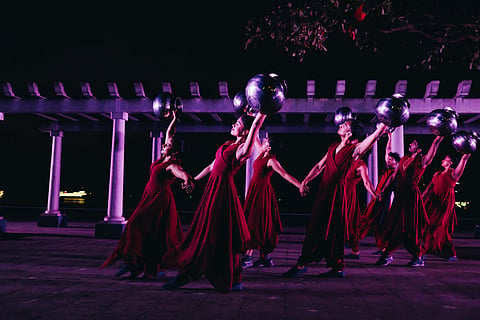

Two years ago, when the Serendipity Arts Festival — one of the largest multidisciplinary arts initiatives in South Asia — approached Jayachandran Palazhy, founder and artistic director of Attakkalari Centre for Movement Arts, Bengaluru, to create a new work, he had already been contemplating a production on the cycle of life.
“It began during Covid. The headlines on migrant workers walking kilometres at a stretch, followed by floods, fire, and conflicts around the world, forced me to think about the future,” shares Jayachandran. This was also the time when a new wave of technological advancements hit the world. “I was wondering how different humans and human life would be then.” These thoughts led him to search for answers for what humans need to do and be for the collective good.
When the opportunity presented itself, Jayachandran’s idea came to life through a one-hour-and-ten-minute performance titled ‘Sonnet of Samsara’. The transdisciplinary performance uses a unique vocabulary of Attakkalari to focus on the human conditions of discovery, transformation, and renewal, while being rooted in an Indian perspective. “The show is a universal experience because it explores human conditions and is made with an Indian filter that highlights the perspectives of bondage, samsara, and maya,” says Vijay Saravanan, media consultant and lighting designer.
The show — produced by Attakkalari in collaboration with Kinetika Design Studio, London, and supported by the British Council — now comes to Chennai. It poses answers to some of the contemporary challenges, such as environmental crises, climate emergencies, conflicts, and societal divisions, by drawing from myths, memories, lived experiences, and imagination. “Myths have lived longer than human memories. Myth, memories, and experience are different iterations of time,” says Jayachandran and that is why he included them in his research and the work that followed.
While the audiences will discover these elements in layers, the show also dynamically adapts to the unique characteristics and histories of landscapes or sites, engaging with the communities that inhabit them. According to Jayachandran, “Architecture is the repository of memories and humans are just carriers.” Through the performance, which includes martial arts, Bharatanatyam, and more, Jayachandran wishes to evoke the spirit of this journey of discovery — what different architecture tells about various times.
Instead of being confined to the long-practised proscenium stage, the work responds to the space it is performed in, transforming with each venue. Vijay explains, “We call it [the show] a site-specific performance, which means it takes advantage of the space itself, the unique architecture, craft, and material heritage and complements the space.”
This also means that the performance itself has grown and evolved with time, from its first staging at the festival and at a mansion in Thiruvananthapuram to the last stage it occupied in the UK. The concept was interpreted by local dancers in the UK, taking on a fresh dimension. “Jay has staged the performance with only two dancers from India and the rest being local dancers from different parts of the UK through workshops. A completely new form of the same performance was presented,” he says.
In its Chennai iteration, the show brings together nine dancers, three musicians — live percussion and mizhavu — various environmental songs, and a recorded track by singer MD Pallavi. Vijay shares, “In live performances, the audience’s energy completely imbues the performance with unique qualities. The energy of the show itself is very unique. And we are looking forward to presenting it and finding the energy ourselves in Chennai.”
In the city, the performance — a celebration to mark Attakkalari Centre for Movement Arts’ silver jubilee — is spread across three days: a site performance at DakshinaChitra on October 3, a formal stage performance at Music Academy on October 4, and a lecture presentation at the Asian College of Journalism (ACJ) on October 6. Jayachandran says, “At DakshinaChitra, it is more of paying homage to the surrounding, the nature, from all we have come, and how it has evolved over time with humans entering different phases in life — childhood, adolescent, adulthood and beyond,” and Vijay adds, “At ACJ, the lecture talks about the journey of this performance, telling the audience about how it came to be, how it was developed, the intricacies of the movement vocabularies and the influences that went into the show.”
As the lights, music, and movements come together, ‘Sonnet of Samsara’ is set to transform the space and create dialogue, not only between the performer and the audience but also the space, each time renewing itself in the process.
