
"One word frees us of all the weight and pain in life. That word is love!” — Sophocles
It’s that time of the year again to celebrate love in all its bright hues. Valentine’s Day may be facing flak in recent years and often dismissed as an imported concept, but who hasn’t ever been struck by Cupid’s arrow? Honouring love has always existed in all cultures since time immemorial. Although in our country, the divine love in our mythologies is what has been acknowledged — carved in stone and painted on ancient temple walls — if one searches the fabric of our nation, one will find quiet stories of intense warmth. Stories of ordinary people who dared to fall in love. Every tribal culture has celebrated these romantic sagas through its art. Ahead of Valentine’s Day, let’s take a look at these simple tales of love from the villages of India.
GOND DEPICTIONS OF LOVE
The Gond tribal community from Central India is renowned for its painting style, which has now even conquered contemporary art markets. Using vibrant colours, this tribal art form, dating back to over 2,000 years, tells its stories of life and love through lines and dots. The Mahua tree is a constant feature in Gond art and, according to folklore, is linked with a romantic narrative.
According to legend, love blossomed between a Brahmin girl and a Gond Adivasi boy. The realities of social structures made this a forbidden inter-caste union, and the desolate lovers were left with no option but to take their own lives, only to be reborn as the Ganja plant and the Mahua tree, once again a reincarnation that could never truly be together. This fable of unrequited love is a powerful reminder of social conflicts in love, relevant even today.

LEGENDS FROM THE MARWARI CULTURE
This is a love story from Rajasthani folklore that has been passed down to generations. It symbolises the spirit of love. In those ancient times, when marriages were solemnised between royal toddlers, Prince Dhola of Narwar and Princess Maru of Poogal, the former a child and the latter an infant, were married and, according to custom, separated immediately after, until they turned adults and could live as a couple. To their ill fate, Princess Maru had to move back to her kingdom when a drought struck. To make matters worse in this childhood sweethearts story, Prince Dhola lost his father, and thus, the memory of his marriage to Maru was forgotten along with that loss. The Prince, completely unaware of his childhood wedlock, married Princess Malwani in his adulthood.
Maru’s love remained strong through the years, and she constantly sent messages to the Prince. In those pre-WhatsApp eras, it was easy for the possessive wife, Malwani, to intercept those messages and ensure that they were never delivered. Finally, Maru sent a group of folk singers to the Prince, and their soulful music slowly awakened Dhola’s childhood memories. Once the mission was accomplished, the Prince set out to Poogal to claim his bride. The journey to and fro was a dangerous one, with dacoit encounters and such, but love overcame every challenge, and the legend still remains in innumerable miniature paintings as a representation of the strength of true love.
PRIMITIVE LOVE
Dhokra, a 4,500-year-old metal casting craft that uses the lost-wax casting technique, belongs to the tribal communities of West Bengal and Chhattisgarh. Using this craft, the community has kept alive a true story of eternal love that originated in Bastar, Chhattisgarh 300 years ago. Jhitku and Mitki met at a local fair, and it was love at first sight. Jhitku was the lad from the neighbouring village, and Mitki was the apple of her seven brothers’ eyes. Not wanting to part from her, they welcomed Jhitku into their household, and life was perfect. And then, famine struck, the village pond dried up, superstition reigned in the desperation that followed, and it was concluded that an outsider would have to be sacrificed to appease nature’s fury. Mitki’s brothers caved in, sacrificed Jhitku, and the heartbroken wife drowned herself in the pond. They live on even today as metal figurines, worshipped for their undying love, in Chhattisgarh.
LOVE THAT BORE FRUIT
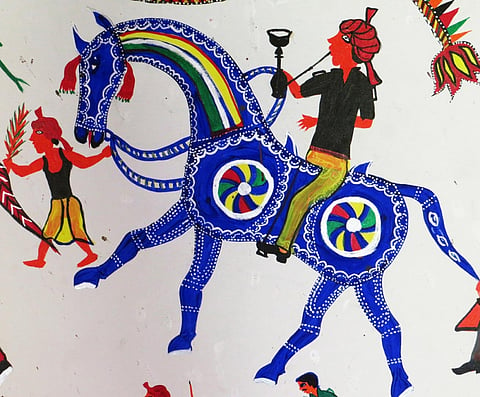
The tribal art form practiced by the Rathwa, Bhilala, and Bhil tribes of Gujarat and Madhya Pradesh, called Pithora paintings, has a pivotal love story as its central theme. The heroine of the tale was Rani Kadi Koyal, one of the seven sisters of Lord Indra. An intimate affair followed when she met Raja Kanjurana in the forest. Their love bore fruit after nine months, and a son was born to the unwed couple. Dreading her brother’s reaction, she abandoned the baby in a stream. The floating newborn was discovered by her sisters, who adopted the baby. Named Pithora, the boy grew up in the household uneventfully until one day, as a result of an angry outburst at his mischief, the truth of his birth was revealed. The story ended on a happy note with the boy being reunited with his parents and a grand wedding that followed for Pithora. The story is considered to be symbolic of the tribe’s divine origins, and most houses paint the tale on their walls, in the belief that it would bring in prosperity.