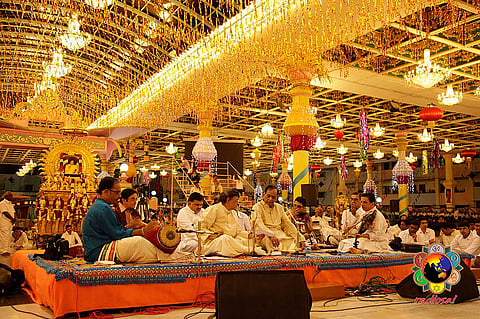

Whistling was never meant to belong in the classical arena. It was a sound associated with impatience, mischief, or interruption. In performance spaces shaped by discipline and reverence, whistling was often dismissed as casual and even irreverent. Yet, over time, that very sound began to change character. Breath steadied, pitch aligned, rhythm sharpened. What once felt intrusive slowly learned to sit inside ragam and talam. The transformation did not happen overnight; it took decades of silence, resistance, and relentless sadhana for whistling to claim its place as music that demands listening.
That quiet insistence is what Chennai’s rasikas will encounter this weekend, when whistling takes centre stage as classical expression. The concert arrives carrying the weight of a long argument — that whistling, when disciplined, can hold sruti, laya, bhava, and grammar just like any other Indian music.
Bringing this art of whistling to the city is Komaravolu Sivaprasad, popularly known as the ‘Whistle Wizard’. His relationship with the art form stretches across 55 years, a journey shaped less by acceptance and more by resistance. “Many senior vidwans rejected me in the beginning. They asked why whistle at all. Some critics even wrote that I was copying what I heard on the radio and gramophone records rather than an independent classical expression,” he recalls.
That criticism forced a reckoning. What followed was a deeper immersion and a return to fundamentals. In whistling, even inhaling and exhaling produce swaras,” he explains. “That stability came from years of practice, hours together, non-stop. Sruti and laya cannot be compromised.” The discipline was not cosmetic; it was anatomical, shaped by lungs trained to sustain phrases the way a vocalist would sustain a raga alapana.
A turning point came when he performed before the late notable Carnatic musician M Balamuralikrishna. The response altered the course of his journey. “He said, raga and swara can be learnt, but sruti and laya are by birth,” Sivaprasad recounts. Declared a special student, he went on to spend two formative years in Chennai under his guru’s guidance, learning varnams, kritis, sahitya, and bhava — the very grammar often assumed to be absent in non-vocal forms.
That insistence on grammar is central to Sivaprasad’s concerts today. His performances follow the same architecture as a traditional Carnatic kutcheri: varnam, kriti, ragam elaboration, swaras, and devotional depth. “People tell me that when I whistle, they feel like I am singing, and words appear in their minds. That comes from bhava and pronunciation, which my guru insisted on,” Sivaprasad remarks.

The struggle, however, extended beyond technique to perception. Whistling, he points out, carries “a bad image” often associated with disrespect. “But today, hundreds of people sit in complete silence during my concerts. That silence is my biggest achievement.”
For this Andhra native, Chennai occupies a special place in his mission. Known for its uncompromising rasika culture, the city represents both challenge and validation. Sivaprasad speaks warmly of Tamil compositions and composers like Paapanasam Sivan and Bhagavatar, noting that linguistic familiarity is not a barrier when bhava is communicated correctly. Over the years, audiences have often mistaken him for a Tamilian, Kannadiga, or Malayali, depending on the repertoire he performs.
The upcoming concert, where he will be accompanied by a traditional orchestra — violin, mridangam, kanjira, and morsing — will focus heavily on devotional repertoire, aligned with Shivaratri. Familiar ragams and kritis are expected, but the emphasis remains on immersion rather than spectacle. Sivaprasad says that he often performs with accompanists on the spot, as “Manodharma cannot be rehearsed,” and it is also part of the joy.
At 70, the discipline has not softened. He continues to practice six to seven hours a day, convinced that he has explored only a fraction of what the art form holds. Recognition has arrived, including an honorary doctorate for whistle music, but it has never been the goal. He says, “I want people to enjoy whistling the same way they enjoy vocal or instrumental concerts.”
Beyond performance, he is now working towards codification: developing exercises, teaching students online across countries, and writing a book to document the technique. It is an effort to ensure that whistling, once dismissed as sound without seriousness, is preserved with structure and respect.
For Chennai audiences, the concert offers something rare, an expansion of its vocabulary. As the city’s musical landscape expands, the art of whistling classical renditions finds the space it was denied for a long time.
Watch Komaravolu Sivaprasad’s performance at the following venues over the weekend:
Carnatic Whistle Kutcheri: February 14, 6.30 pm onwards at Sri Sundaram Vinayagar Temple, Puzudhiwalkkam
Classical Whistle Concert: February 15, 5 pm to 7 pm at Anandam (Home for Senior Citizens), Kallikuppam, Ambattur
Open for all