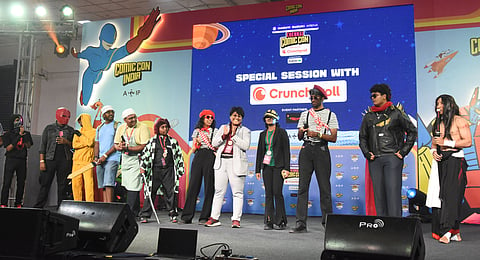

Conventions like Comic Con are usually narrated through the eyes of the attendees. These narrations often touch upon what the attendees cosplayed as, the fandoms they represented or even the sense of belonging that made every self-proclaimed nerd feel at home. But that’s only half the story.
Shift the spotlight, and you’ll find the artists, creators, and writers, who have been powering these fandoms for years, building the very worlds that fans celebrate. While established names draw devoted followers, platforms like Comic Con India do more than spotlight the familiar ones alone. They nudge casual visitors toward comics and offer vital visibility to creators, both indie and otherwise, who may not yet be household names but whose work is steadily shaping the comic scene.
To understand that side of such conventions, CE spoke to five artists who attended Comic Con Chennai — from veterans with over 25 years of experience in the industry to fresh voices just finding their footing — about their work, what it means to meet the audiences face-to-face, and how they hope to be remembered.

Prasad Bhat, Bengaluru-based illustrator
The craft:
Founder of Graphicurry, Prasad swapped his career in engineering for illustration in 2010, and went on to gain global recognition for his caricature series titled 'Evolution' which charted actors’ journeys across decades. Commissioned by The Walt Disney Company to reimagine Mickey Mouse for his 90th anniversary, this Bengaluru-based artist has also collaborated with major brands like Amazon Prime and Marvel.
Con and calling:
Talking about the annually held convention in metro cities like Chennai, Prasad says, “Comic Cons happening in Indian cities are giving Indian illustrators something very important, which is visibility with context. Online, your work can travel anywhere, but at events like these , people experience it (visibility) in person. That feedback is immediate and valuable. It helps creators think beyond just making art and start thinking about sustainability and scale.” He adds that when Indian artists’ original work is backed by a strong local audience, credibility is built organically. “Global collaborations usually come when there is consistency and identity. Platforms like Comic Con help reinforce that identity. They show that Indian artists are not just participating, but shaping the space.”
Beyond the stage:
When the crowds and the creators go home from Comic Con, Prasad hopes that people leave with a “sense of ownership,” knowing that Indian comics are “not a smaller version of something else”. He adds, “And if they walk away believing that Indian creators deserve a bigger space globally, then that is a good outcome.”
Parting advice for up and coming artists:
“The key is honesty. Audiences are very sharp. They can sense when something is authentic. At Comic Con, the creators who stand out are usually the ones who are comfortable being themselves,” Prasad notes.
Akshara Ashok, Freelance illustrator, Happy Fluff Comics
The craft:
At Happy Fluff Comics, Akshara explores everyday life, body image, sex education, and mental health, through simple and relatable storytelling. She began in 2017 while studying architecture and has since turned comics into a full-time practice rooted in honesty and humour that helps break taboos.
Con and calling:
Akshara believes that when socially conscious artists such as herself are invited to Comic Con Chennai, it validates them. “It’s a reminder for us that our work matters and there’s enough space for all of us, regardless of our art style and the topics we discuss.” When it comes to the indie community, such conventions double up into art showcases too. “It helps us put ourselves out there where people can see that we’re real. This can convert into corporate orders, collaborations, and publishing deals,” she hopes.
Beyond the stage:
For this artist, the takeaway goes beyond personal recognition. More than being remembered, she hopes attendees leave with the understanding that art is a viable career. “I have had people come up to me and ask if I have a real job outside of this or if I can manage to make a living out of art alone. I hope seeing so many artists running successful businesses (at Comic Con) changes that mindset,” she concludes.
Parting advice for up and coming artists:
She hopes creators use art to engage, to question, and to navigate conversations that might otherwise feel difficult to begin.
Rajesh Nagulakonda, Illustrator and art director
The craft:
Rajesh transitioned from studying biology to building a career in illustration, working with publications like 'Chandamama' before discovering his stride in visual storytelling at Campfire Graphic Novels. With over a decade of experience as an illustrator and art director, he has shaped titles such as ‘Krishna: Defender of Dharma’ and ‘Ashoka: The Mauryan King’. His concept art has inspired over 150 murals in Ayodhya, too.
Con and calling:
Meeting passionate comic fans, students, and enthusiasts at such conventions sparks joy for Rajesh. “I get to share my original artworks with the audience and explain the ideas and concepts behind them in detail,” he says, adding that such interactions have helped him understand what the audiences are seeking and align his project ideas accordingly. For instance, he admits to how young readers of his graphic novel ‘Chanakya’, always asked him if it was based on facts or fiction. “Such interactions clearly show that readers are seeking authenticity rather than mere reinterpretations. That is one of the reasons my upcoming comics and graphic novels are adapted directly from the original scriptures,” he reveals.
Beyond the stage:
Long after the lights dim, Rajesh hopes his art continues to live in small and personal ways, as a memory for one and as a phone screen saver for someone else.
Parting advice for up and coming artists:
“It is not easy to break free from global influences. Yet, I urge young artists to carve out their own identity in storytelling. Dare to make mistakes. And if you must repeat them, repeat them consistently, because what begins as a flaw can eventually evolve into your unique style statement.”
Sai Keerthi Akaash, Concept artist, illustrator, Visualize
The craft:
Sai is a Chennai-based concept artist and illustrator with over six years of experience across film, television, gaming, UI/UX and publishing. Comfortable moving between chaotic chibis to soft watercolours and anime-inspired frames to grounded realism, his work is defined by versatility and strong visual storytelling.
Con and calling:
Sai views conventions like Comic Con as spaces where creators, publishers, and audiences converge with purpose under one roof, where conversations can turn into possibilities. He admits to having met people willing to fund his ideas, back his projects and even collaborate on future work. “It has been a huge opportunity for artists like me. The direct support gives creators like me confidence to build original IPs [Intellectual Properties],” he says.
Beyond the stage:
“I hope people remember art, admire it and appreciate it in any form or capacity. Because everyone is running and chasing the high. If someone walks away from a Comic Con feeling inspired to create or support Indian artists, that means everything,” he asserts.
Parting advice for up and coming artists:
Sai says, “Today’s fandom is incredibly aware and visually sharp. Adaptability helps artists speak multiple visual languages, but what truly makes you stay relevant is authenticity.”
Savio Mascarenhas, Tinkle’s hero-maker and group art director at Amar Chitra Katha
The craft:
Savio is the long-time artist behind 'Shikari Shambu', whom he has illustrated for over 25 years. A former advertising professional, he transitioned into comics under the mentorship of Anant Pai — the founder-editor of 'Amar Chitra Katha' and a pioneer of Indian mythological storytelling through comic form.
Con and calling:
Having witnessed 25 years of the Indian comics industry evolve, Savio explores where Comic Con fits into that journey. “Comics have been one of the most favourite literature for decades here. We do have a massive fan following, specially in the southern states. It’s only because of Comic Con that it is possible for us to meet our readers and interact with them, get their feedback, and understand what they would want from us.” In these two plus decades, he notes that more youngsters are willing to try out lucrative careers in creative fields and adds that events like Comic Con have kindled heightened interest in comics and animation as a career.
Beyond the stage:
He hopes his work is remembered as something families return to and as stories that keep the child inside everyone alive.
Parting advice for up and coming artists:
“A genuine creator is the one who strives, is persistent, innovates, and evolves. These traits will surely help one carve their own identity in the long run,” he says.