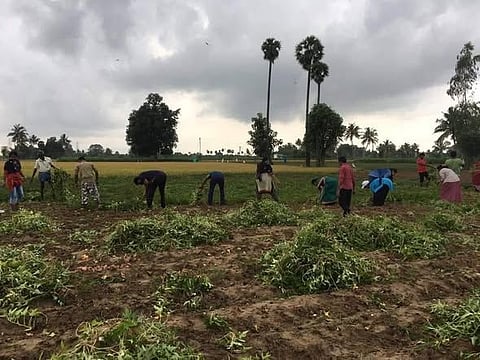

In late December and early January days, the chill of the night fades into the warmth of the day, whilst winter’s breath still brushing past, the first ray of the sun — symbolising new beginnings — casts golden hues that bathe the greens, yellows, and browns of the leaves, flowers, and stems. All around, crops are heavy and ripe, bending gently as they await harvest. Cutting through these acres, one can see farmers, unfettered by the weather or the time, beginning the day’s work.
“I come to kalani (farm) as early as 5 am during the season and leave only in the evening,” says K Jaya, who has been farming for almost 60 years. “I go to the farm at 6 in the morning and return by 9 am. If there is a lot of work, then I stay till evening. When it comes to work, I work hard because I want to see food on my kids’ and everyone’s plates. That keeps me motivated,” shares Mohanan V, an organic farmer with over 70 years of experience in agriculture. He adds, “From the age of five or six, I have been going to the fields every day. My father used to take me with him and made it a point that I continue farming. There were many times when I wanted to quit because of the lack of manpower, but I would always ask myself, ‘if not us, who will feed the citizens?’”
Farmers like Mohanan, Jaya, and millions of others ensure that our plates — and stomachs — have something to hold. Its not merely said that farmers are the backbone of our country. Harvest festivals are a way of showing gratitude towards farmers, the earth, and the sun. CE takes a field day to trace how farmers prepared for the four-day festival — Pongal.
Around 20-25 days prior to Bhogi — day one of four — Mohanan wields a sickle and harvests paddy in his three acres of land. Mysore Malligea and Seeraga Samba are some of the rice varieties this farmer from Chengalpattu specialises in. “In this district, farming is highly dependent on eri (irrigation tank), and you get abundant water between the months of August and March. In this period, I crop paddy, and for the rest of the months, veyil kaalathula kaigari vedhaippom (vegetables are harvested in the summer), such as lady fingers, brinjal, among others,” notes Mohanan.
The harvested paddy is first dried, then sent to the factory to be processed in a machine, and finally sold at Rs1,700-Rs1,800 for 25 kg. When asked how fruitful the business is, Mohanan says, “In agriculture, one cannot see profit and loss; our aim is to feed people.”

He uses his harvested rice from the field to cook pongal at home. Similarly, Jaya and Sangeetha P, a mother-in-law and daughter-in-law duo, use the sweet potato produced on her farm to offer to the Sun God during the festival. At their farm, they sow sweet potato slips (rooted sprouts) during the month of Purattasi (mid-September to mid-October) and harvest it between 90-120 days. “We do so especially during Pongal because sweet potatoes to the Sun God are ugundhadhu (perfect). Poosanikai (Pumpkin), sakkaravalli kezhangu (sweet potato), and manja kezhangu (turmeric root or fresh turmeric) are important ingredients,” notes Jaya.
Pumpkin leaves are used as a serving plate to offer food to Sun God. “Now, you don’t see a lot of them following this tradition because of the lack of availability of the leaves and use banana leaves. It is a ritual followed by our forefathers,” says Jaya, while Sangeetha adds, “We don’t understand the reasoning behind these practices; we follow them because it is said that is how our ancestors performed rituals.”
The agriculturist pair from Thiruvallur district commence their work two weeks prior to Pongal because that is the period when sweet potatoes are in demand. On day one, vines are removed, the next day follows ploughing, harvesting sweet potatoes, washing them in water — a common water pump in the farm — by spreading a pardah (a polyester fabric banner), a local parlance, then they are filled and tied in a koni pai (jute bag). The bags are then loaded into a van, which goes directly to the Koyambedu market. “The rate is fixed on demand. Last year, it went to Rs 2,800 per bag, and we sold 27 bags. It is said that the price is less this year,” explains Sangeetha.
Soil to sun and back
On the four days, starting with Bhogi, the practices in the field are quite different. “We don’t burn clothes here, but for the sangiyam (ritual), we burn old mats. In the evening, we cook non-veg — meen kuzhambu and chicken. Since Bhogi falls on the last day of Margazhi, many break their fast — they avoid meat, onion, garlic — and eat,” she shares.
On this day, the family buys a new mud pot, which is used on Perum Pongal to cook pongal. Sangeetha says, “On Pongal day, there is no work at the kalani. At home, on varatti (cow dung cakes), we make pongal in a paanai. But now, even the varatti is in demand.” Pongal is cooked in a big pot and offered to the Sun God, and in another one, they cook all the vegetables. When the pongal dish boils and overflows from the pot, the water is collected and sprinkled across the farm, denoting prosperity.
On Maatu Pongal, day three, there is a lore in their village that Lord Shiva visits to see cows on earth, as the cows (Nandi) are loyal vehicles (vahana) to Shiva, says Sangeetha. The cattle owners bathe and decorate — paint, tie balloons to horns — cows to show that they take good care of the cattle. “It is a saying that cows go to Lord Shiva and Parvati and complain that ‘Look, how farmers beat, use me to plough, do not take me to the waters, not serve enough food’ and the deities come check on them on this day,” explains Jaya.
On the fourth day, all the farmers unite and come to the farm, pray to god, and make sweet pongal (sakkara pongal). “This work is nothing less than a corporate job,” comments Sangeetha. Once the celebration draws its curtains, malli poo, the duo’s major source of income — will be ready for harvesting. In their field, naduvu naduradhu (sowing or planting) is done only by the females and the removal of weeds and vines is done only by the men. The cycle continues. Mohanan, on January 21, will sow his new crop. Jaya and Sangeetha will work with ground nuts and jasmine flowers. These festivities mark the sun’s transition to the northern hemisphere (Uttarayana) and the beginning of the harvest season, representing prosperity and an abundance of food. Offering the first fresh crops, is a way to express gratitude to the sun.
As the profession slowly wanes because of “lack of manpower,” as Sangeetha says, a few remain clutching the practice not just as a livelihood, but as a way of life. Each evening, they make their way through the balk, breathing air tinged with the scent of sweat and soil, carrying the heaviness of work that begins before dawn and ends with dusk. While hope carries some forward, others move through the days weighed down by survival. An optimistic Jaya says, “Until there is water, we will continue farming,” whereas Mohanan concludes, “Agriculture is going towards destruction. People are changing. They leave their farms to go work in a company, and they don’t even wish for their kids to enter the fields.”