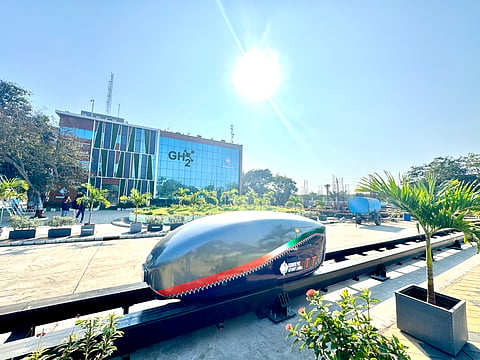

CHENNAI: In a major boost to India’s push for smarter port logistics, TuTr Hyperloop Pvt. Ltd., an Indian Institute of Technology Madras-incubated startup, has successfully demonstrated a prototype cargo transportation system based on Linear Induction Motor (LIM) technology at a major port in Gujarat.
The trial was conducted at Deendayal Port Authority, one of the country’s busiest maritime gateways, giving hope of electrically powered cargo movement systems as ports in India grapple with congestion, rising cargo volumes and tightening environmental norms.
Under pressure to move freight faster while reducing emissions and improving efficiency and productivity, the LIM-based transport, where electrically powered cargo pods travel along fixed tracks using electromagnetic propulsion, has caught the attention of policy-makers and ports.
TuTr co-founder Aravind S. Bharadwaj said the indigenous propulsion system performed as expected during the Kandla tests, marking a key step in taking laboratory research into live industrial settings. Now Tutr is planning to conduct a economic feasibility study on implementing the technology.
Encouraged by the results, the port authority now plans to advance to a live demonstration of a magnetic levitation, or maglev, platform — a move that would position Kandla as a testbed for next-generation port mobility solutions.
Sushil Kumar Singh, chairman of the port authority, said the trial underscored India’s growing capability to design and deploy complex transportation technologies domestically. Supporting a maglev pilot, he added, fits with the port’s long-term vision of building smart, sustainable and globally competitive infrastructure.
LIM systems are fully electric, involve fewer moving parts and can be operated autonomously, helping cut fuel consumption, maintenance costs and emissions. Compared with conventional wheeled systems, LIM-based transport offers smoother acceleration and lower mechanical wear — features well suited to high-throughput port environments.
For TuTr Hyperloop, the deployment represents a milestone in translating academic research into scalable industrial applications. Bharadwaj said the planned linear propoulsion was successful and we are planning for a magalev trial, a natural extension of the company’s roadmap to deliver indigenous mobility solutions for ports and logistics, with scope for adoption in India and overseas.
If the proof of concept scales successfully, the Kandla project could serve as a template for similar collaborations between ports and deep-tech startups, aligning with the Centre’s Make in India and Atmanirbhar Bharat agendas to embed home-grown innovation in critical infrastructure.
