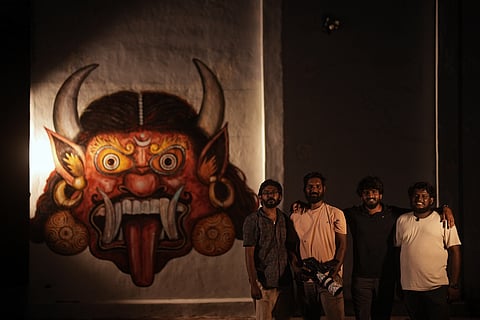

You see them while entering a house, on roads, on rooftops, on walls in public spaces, in vehicles, in temples, in factories, at construction sites, and several other places, but walk past it as if unnoticed. They sometimes have a perfectly round face, other times an out-of-proportion figure in yellow, black, white, and red, with big, wide, and bold eyes, tongue as long and bright as a warning sign in red, sharp, edgy fangs, moustache curled in the ends, and ears huge as open palms warding off harm.
You probably might have guessed the figure. It is an integral part of all cultures, not only in Tamil Nadu and India, but across the globe. In Chinese and Indonesian culture, these forms appear as murals; closer home, in Madurai, Sivakasi, Aarani, and beyond, drishti bommais are inspired from human faces, and the features resemble — bulbous nose, playful eyes, plumped lips, and so on.
Believed to distract, absorb, and neutralise negative energies, this everyday practice of warding off evil using drishti dolls gained attention from Indicus Paints (VNC Group). They produced and premiered a documentary on drishti bommais on their official YouTube channel (@IndicusPaints), directed and written by Saravana Siddharth. He researched for six months followed by extensive field exploration to prepare the proposal.
Saravana says, “When I started this project, I wanted to make a 40-minute-long documentary as it [drishti bommai] is a vast subject. It is an ancient as well as a folklore belief globally.” He began shooting this documentary in August 2023 with a team of DOP R Vigenshwar, associate director Shiyam Sunder Vel, and assistant director Harikrishnan.

While the official release from the company, titled ‘Drishti Bommai: Reviving the Tradition’, was released on December 11, 2025, CE got exclusive access to the director’s cut, which is to be released soon under the title ‘Kollikannu: The Envious Gaze.’
Travelling the straight roads and the curvy lanes of the state, Saravana, in his research and conversations, found that the belief in drishti exists across all classes and castes. “Everyone seems to believe in it. However, the fear is often more intense among the upper class, who have more wealth to protect,” notes Saravana, speaking from the fourth floor of a building, spotting a drishti bommai painted on a very old building. “The doll looked weathered, with its paint peeling off. It was the specific style of doll I’ve only ever seen in Chennai,” he says.
A tool for deviation
For Saravana, the practice seems ironic. “Everyone seems to believe in it. However, the fear is often more intense among the upper class, who have more wealth to protect.” While they often paint huge life-size dolls, the painters, who are from marginalised communities, follow this practice in their own way. Meanwhile, a vegetable vendor even refuses to repair the damage to his vehicle to ward off evil eye.
A nomadic tribal community, Boom Boom Mattukaran, near Aarani, plays a vital role in warding off the evil, shares the director. In many ooru thiruvizha (village festivals), the proceedings begin only after the people from this community enter with their bull. “The Boom Boom Maatukarar community once used bulls to tell fortunes and ward off drishti. Today, most have switched professions. Very few still keep bulls, as the younger generation has begun attending schools and colleges,” shares Saravana.
The types of drishti bommais differ. For example, a brick maker at his kiln uses white kolam powder to outline a human body. “This is also an evil eye practice. It differs from profession to profession and class to class. Lorry drivers paint a yellow face with a bright red tongue sticking out, and sharp teeth,” shares the director.
At its core, the amount of wealth — movable and immovable assets, liquid funds, or otherwise — procured by individuals is directly linked to the fear of safeguarding it. “The basis of the concept of warding off evil, drishti, is fear. As humans, by nature, we are jealous. We need something to hold on to to lead everyday life, be it a belief or a physical object, and drishti bommai is one such tangible item,” he says.
In the documentary, Chandru Guruswamy, artist, poet, and principal (retd), Government College of Fine Arts, Chennai, says, “Don’t be mistaken for thinking this is a new practice. About 40,000 years ago, our ancestors carved a doll in an elephant tusk with a lion’s face and a human body. It was found at an archaeological site in Europe. This shows that people started believing in the evil eye.” The first known evidence of the evil eye to mankind is now open to the public at the Royal British Museum. He adds, “We transform our fear of death into a doll. You need a doll to address your fears. You transfer your death fear into dolls”.
In different sizes and shapes
The documentary is shot through the eyes of an artist who paints these dolls, Munuswamy, artist Chandru, the locals of Aarani, and the kids from the Boom Boom Maatukaran community.
The director chose Aarani because it houses huge rice mills where the practice of drishti paintings is scaled to the size of a mural, as commonly seen in China and Indonesia. Saravana explains, “In Thiruvannamalai, Aarani, and Vellore, superstitious practices are deeply rooted. Hence, there are 30-foot-long drishti murals here. In Erode, Kongu Nadu, Sivakasi, and Madurai, the paintings got upto 4 to 5 feet maximum.”
To sustain in the job and feed their families, Dalit artists like Munuswamy portray the drishti figure with longer hair, big earrings, and nose rings, as add-ons to the designs. “The artists are exploring new patterns and introducing them to our local culture. They want to deform the face further; They want to make the face look more monstrous,” he explains.
Rooted in past and future
While the fears of sustainability and going home empty pocketed are a concern, Chandru says, “You may fear about your next paycheck, fear for your accumulated wealth, well-being of the family, but you cannot fear that the art you created be taken away from you. Once created, it is always going to breathe in this world, unless destroyed intentionally”.
The practice of painting this art is rooted, traditional, and heavy on the pockets. Individuals also ward off drishti with other factors. A whole ash gourd (poosanikai), is used. “It is a common belief that when the pumpkin [ash gourd] is broken and the contents scatter, the evil eye is warded off. Even coconuts are broken. This practice is commonly seen in under-construction buildings,” points out Saravana.
Moving on from poosanikai and paints, as the human species evolved, the process of warding off evil advanced. Today, you get drishti moulds from Andhra Pradesh. In Tamil Nadu, villages near Tiruchy and Madurai manufacture these moulds to produce dolls.
Rooted in collective belief and lived experience, this practice transcends geography, religion, and time. Across cultures, it emerges from a shared human instinct — the need to protect oneself from misfortune. Whether in the form of murals, talismans, threads, nazar gajra or drishti bommais, the practice is woven into daily life rather than ritual alone, passed down through generations as inherited wisdom.
A practice, called akki varairadhu, is common in Kosapet and South Tamil Nadu, where a reddish powder is rubbed all across a newborn baby’s body, and words are written. “The belief is that this practice keeps kids away from diseases,” Saravana says. This warding off of evil eyes goes on until a man breathes his last. “Nara vali varaikkum, drishti kalikkurathukana oru extension iruku (the extent to which this practice goes is human sacrifice),” he concludes.
Did you know? Saravana shares some information from his research: The blue and white concentric circle evil eye sold in the Indian market is popular in Mediterranean countries. The evil eye belief is found to be on a large scale in the Middle East and Russia. Across African regions, the evil eye practice is expressed through flamboyant visual forms. The indigenous tribes in New Zealand paint bells as monsters and dance with them in festivals.