
hink of a music director. Was it a male or a female? In all probability, it might have been a man. But can you, just as quickly, name a female music director? If you are not able to, it isn’t because women lack talent in Kollywood; we have countless singers, a few lyricists, a handful of music composers, and even orchestra arrangers. The gap here stems from how the title and recognition that comes with being a music director have largely remained with men.
Now, imagine a grand concert stage. Picture the vocalists, chorus, instrumentalists, the lights, the LED screens, the fireworks, the fog machine filling the stage. I suppose your mental image accommodated women, except only as the main or chorus singers, unless you are thinking of the recent AR Rahman Concert in the city.

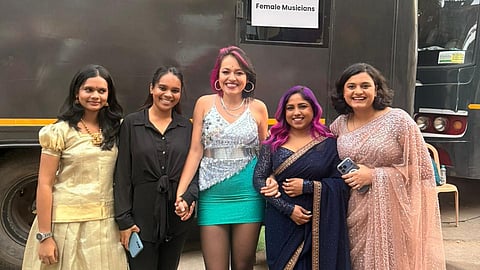
The show, held on Valentine’s Day, celebrated its women performers so visibly that social media buzzed with conversations about representation. Many called it as they saw — a rarity for so many women instrumentalists to share a single stage, that too before a massive crowd and alongside a leading music director. While most discussions stayed focused on what unfolded on stage, the musicians open up about their experience, what it felt like to share a stage, and the journeys that brought them together.
Haritha Raj, who played a reinvented veena that she calls Ayizhai, reflects on the contrast. “I began this journey of playing live music ten years ago. Every show that I went to, I was the only woman instrumentalist on stage. I have felt a little lost among so many men on stage, not that I didn’t love working with them, I did, but the gap has always been very clear.” Angelin Naveena, who has been playing the trumpet for Rahman for several years now, adds, “The last ARR live I played was in Coimbatore in 2024. At that time, too, there were not many women instrumentalists. Men were dominating the band. I found it difficult to connect with them as I was sharing the caravan with the female singers.” Nilananjana Ghosh Dastidar, the singer and bass guitarist who has been working with the maestro for five years, corroborates and admits to never having seen so many women instrumentalists on one live stage in India and “that too, playing so admirably and passionately.”
Much visibility, the women say, has usually come in specific contexts, such as when these musicians are invited to perform as part of an all-women band. Dr Rangappriya Sankaranarayanan, who played the violin, for instance, is the founder of Pravaham, an all-women band. But even the stages they perform on rarely match the scale, reach, and audience size that mainstream concerts led by major music directors garner. “Only in such performances are we surrounded by women, but they are often intended to make a statement,” Haritha notes, adding that turning them into a deliberate gesture toward representation rather than a reflection of a common practice.
Origins
For some, opportunity arrived early. Amrithavarshini Manishankar, who plays Thavil, for instance, was discovered by Rahman through social media at just 19 years of age. It became the turning point of her journey, she says. Angelin, meanwhile, joined KM Music conservatory and ARR’s orchestra and started getting opportunities to play live for him in 2019, aged 16. For Nilanjana, Rangappriya, and Haritha, the path was longer. Their break came only after years of persistence, from competing in music reality shows to performing on small local stages. Haritha even recalls those years with candour, when even daily meals were uncertain.
Though their beginnings are starkly different, shaped by chance, struggle, discipline, and practice, they all eventually found themselves on the same grand stage. Nilanjana frames it poetically: “Music became our shared language and our unifying rhythm. Nothing else mattered.” Angelin, too, talks about fleeting moments on stage that felt like pure female camaraderie. Sometimes, it was as simple as a reassuring smile exchanged mid-performance. At other times, it was “head-banging a little harder in encouragement. That felt like an interaction between us, and we were really enjoying ourselves on stage.”
But above all, it came down to how the audience responded. Watching reels of them playing on stage go viral after witnessing the live crowd cheer for them with the same energy reserved for headliners, they say, made their day. “It is one thing to be recognised by Rahman sir and to play by his side on such a huge stage, and it is a whole other thing to be celebrated by the audiences,” Haritha sums up.
What matters just as much is how the moment translated into tangible change for the women on stage. Amrithavarshini reveals that after performing for Rahman, she has signed four recordings. For the others, beyond their ongoing projects, the impact has been more personal and no less powerful. They speak of a renewed self-confidence and of learning to see themselves differently. “To see myself on a stage like that, it made me feel content. And to call myself an AR Rahman artiste feels surreal,” Rangappriya says.
They hope the ripple effect travels further. “If a young girl in the audience or scrolling through the performances’ clips felt inspired to pick up an instrument, that means we did something right,” Nilanjana says. Angelin adds that if they especially picked up an instrument rarely associated with women, such as a brass instrument, or the thavil, then the stage would have inspired them rightly.
Will this kind of representation encourage other big names to include more female instrumentalists? The women are optimistic and believe that visibility at this scale has a way of shifting industry habits. They also hope that this representation slowly becomes a routine.
But when the question turns to something bigger — if they can imagine a woman music director being celebrated at the same scale in India — there is a pause. They want to believe it will happen. Some, like Nilanjana, even propose a timeline of six or seven years. Yet almost every answer circles back to a lingering “maybe.”