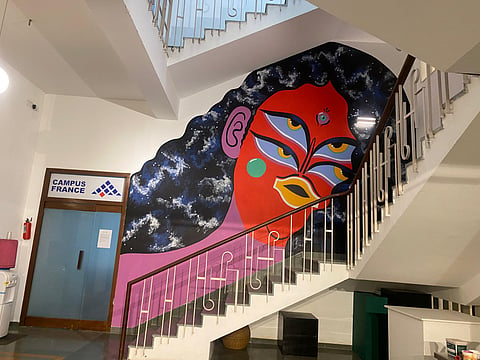

The city’s walls have been steadily turning into canvases in recent times. From the colourful murals brightening neighbourhoods such as Kannagi Nagar, Nungambakkam, and Guindy to striking portraits of home-grown personalities appearing across North Chennai, the city’s public spaces are increasingly being claimed by art alongside posters and political art works. Against this backdrop of a growing street wall art culture, the fifth edition of the Wall Art India initiative arrived in the city earlier this week, bringing an international urban art movement into conversation with the city’s growing visual landscape.
Organised by the Alliance Française network in India, in collaboration with the Embassy of France in India and Institut Français, this festival is travelling across 15 cities in the country, bringing together four artists from India and France to create large-scale murals. The Chennai segment of ‘Wall Art India’ was hosted at Alliance Française Madras from March 1 to 4, where French artist Kashink worked on a mural that reflects this year’s theme of ‘Women, Horizons and New Voices in Urban Art’, in time for International Women’s Day.

For Kashink, whose work involves vibrant colours and strong feminist undertones, the theme resonates deeply with a broader idea rooted in Indian philosophy. She says, “The art show is about Shakti, celebrating the feminine divine. It’s not only about urban art, it’s also about our time to be able to speak out about our experiences and share them with others.”
The artist believes that contemporary conversations around gender and identity transcend geographical boundaries. “We live in a very interesting period of time where we can actually get together and realise that our experiences are so common from one country to another. It’s something that goes beyond culture,” she adds, noting that her mural draws inspiration from what she describes as “the cosmic forces of Shakti”.
Although she spent only a few days in Chennai, the city has left an impression. “I was at the beach during the full moon and it was so beautiful. The moon was pink and reflecting in the water, it was absolutely amazing,” she recalls. “That’s the impression I get here of this connection to nature, yet in a very big city.”
For an artist who has spent two decades working in public spaces across the world, Chennai’s visual culture is particularly fascinating. “Public spaces everywhere in the world are packed with advertisements and political messages,” Kashink notes. “My goal is to disrupt that public space and bring something that is not promoting products or political parties.” However, she adds, “My art is political in its own way, but it is also a way to bring art outside museums and institutional places where art is sometimes reserved for the elite.”
Interestingly, she finds echoes of themes of identity and gender within Indian cultural traditions. “In Indian traditions, the idea of balancing the feminine and masculine sides within yourself already exists. Exploring identity is really about getting to know yourself better…to accept and embrace who you are.” she explains.
For Kashink, street art is not confined to one purpose. “Street art is activism, self-expression, and a public conversation at the same time. As artists, it is our role to create public conversations and question social norms,” she says.
Two decades ago, she claims, the international street art scene had only a dozen women, however, over the years, many women have taken over the space to express themselves without any fear.
Ultimately, Kashink hopes that the mural she leaves behind in Chennai will resonate beyond the present moment. “I hope people feel inspired to be okay with who they are and to accept themselves, even reaching a place of self-love. What I want my art to do is bring joy and reconnect people with their inner child,” she remarks.
Ahead of this International Women’s Day, she says, “It’s important to remember that we can all connect with our creativity. And when we do that, we can connect with bigger energies, positive energies, creation, life, light.” She adds, “Women have their creative potential — men do as well — but it’s very important that we practice this creativity”.
As Chennai’s streets continue to evolve into open-air galleries, initiatives like Wall Art India reinforce the idea that art does not have to remain confined within museum walls.