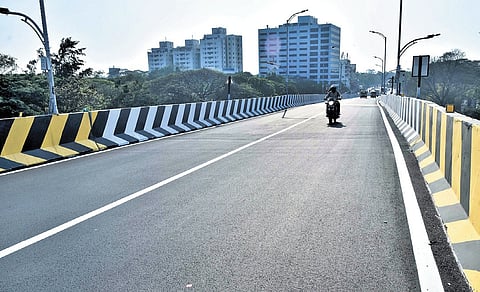

CHENNAI: Following complaints from motorists, the state highways department has overlaid the concrete stretch of the Madhya Kailash flyover with a bituminous layer. Official sources said this would improve riding comfort and would not significantly increase the load on the structure.
“Flyovers built by the state highways department and currently in operation at Vadapalani, Porur and other locations have bituminous layers. So laying tarmacadam over the concrete surface is well within the department’s protocol,” a senior official said.
He also dismissed safety concerns, stating that the additional weight on the flyover is insignificant and the structure remains safe. However, several other state highway flyovers, including those at CMBT and Medavakkam, are still in use with concrete surfaces.
On Wednesday night, the flyover at the Madhya Kailash junction was closed to traffic to lay the new tarmacadam layer and was reopened on Thursday morning.
The 652-metre-long L-shaped flyover connecting Sardar Patel Road and Rajiv Gandhi Salai at the Adyar-Madhya Kailash junction was opened for traffic on February 15. The project was completed at a cost of Rs 60.68 crore.
The unidirectional two-lane flyover was built to ease congestion on the IIT Madras-Adyar Cancer Institute stretch. However, a section of commuters had criticised the structure, saying they experienced a bumpy ride along more than 500 metres of the flyover.
While around 50 metres on both the ascending and descending ramps had a bituminous layer, the remaining 550 metres of the carriageway were reinforced concrete. As the structure is L-shaped, motorists also had to negotiate a sharp turn along the curve, prompting safety concerns. This led officials to lay a 25-mm-thick bituminous layer over the concrete surface.
S Anandan, a resident of Thiruvanmiyur, said, “Travel comfort on the bituminous road is relatively better compared to the previous concrete surface. Earlier, riding a two-wheeler was highly uncomfortable.”
