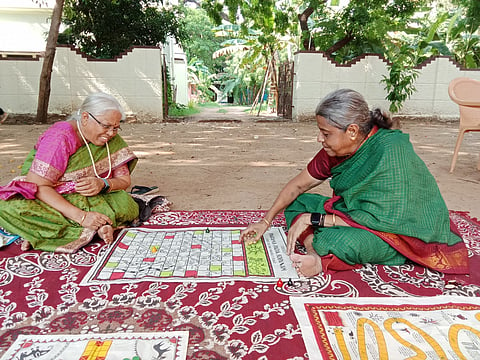

All over the world, the first week of March becomes a time when people suddenly become very vocal about the role of women in our lives. Women’s Day wishes fly across the world. Organisations ramp up activities celebrating women, and conferences are organised highlighting the importance of women in the workforce. Homemakers are celebrated, and qualities commonly attributed to women are romanticised through songs, poetry, and more. I often wonder at this upsurge that dies away by the middle of March.
To a person like me who has delved deep into the world of traditional games, I, as always, turn to them for my answers. As usual, they did not fail.
I am reminded of the story of Shiva and Parvati and one of their numerous games of dice. The fact that Shiva and Parvati played together creates the image of a young couple in love who find ways to spend time together. However, the excitement of the game and the desire to win are strong, and all the love in the world is set aside in the face of this.
During one of those games, Parvati won, and Shiva lost his trident to her. He did not give up and continued to bet, finally losing all his possessions. This part of the story highlights the tragedies of gambling. The charm of many of our old stories is the fact that there are many lessons in each of them, and although the plot line is focussed, other lessons can be learned on the way, making it a holistic experience.
Upset by his defeat, Shiva wandered away and ran into Vishnu, who promised to help him recover his belongings in the next game. So, Shiva and Parvati played again, and this time, Shiva won the game. Parvati was suspicious and called him a cheat — a remark that led to a quarrel between them. Finally, to appease the couple, Vishnu came to them and told them that his spirit had entered the dice and controlled their fall. He explained that neither of them had lost or won, but that the game was an illusion and their quarrel was a product of their delusion.
The story does not end there. In a subsequent conversation, Shiva tells Parvati that the world itself is an illusion and nothing is real. Parvati, the mother of all material things, loses her temper: “If everything is an illusion, let us see how the world gets on without me.”
She then disappeared from the world — a disappearance that caused havoc. Time stood still, seasons did not change, the earth became barren, and there was a terrible drought. Seeing all the suffering, Parvati’s heart melted, she reappeared, and the world order was restored.
This, to me, is the very essence of the Women’s Day message. No matter what, the world cannot survive without women. Whether her role is home maker, bread winner, mother, daughter, sister, or any other, she matters every day. Not just on Women’s Day.
