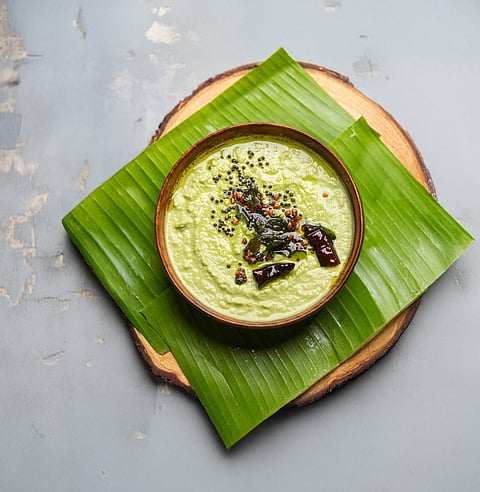

"Ammikal la aracha chutney thaan asal chutney.”
If you grew up in a Tamil household, chances are you’ve heard that line tossed across the kitchen usually by a paati who gives the mixie a bombastic side eye. The stone grinder, heavy and unmoved in a corner, carries not just weight but tradition. As years passed taking in consideration the makers’ efforts — typically the matriarch of the house — and time consumption, the whirr of a modern blender entered the cooking scene. Yet the age-old saying makes a cameo whenever any kinds of chutney is served on the plate.
In homes across India, chutney isn’t just a side dish. It is memory ground into paste. It is improvisation, inheritance, and instinct. Say the word ‘chutney’ out loud, and what comes to mind? For a Chennaiite, perhaps coconut churned with green chillies and tempered with mustard seeds. For someone from Andhra, a tangy gongura pacchadi. For a Maharashtrian, a thecha that clings to bhakri. For a coastal kitchen, maybe even dried prawns or crab. Different in tastes, preference, consistency, ingredients, methods, yet still the dish resonates with the whole country. Chronicling all these in her latest book ‘Chutney: A Compendium of Stories and Recipes’ (Rs 3,500, A Perfect Bite Consulting), Rushina Munshaw-Ghildiyal, a culinary consultant and chronicler, unfolds about the experience.
“Out of all the topics that we celebrate, nothing is as resonant as chutney. Speak to any Indian, andsay chutney, they’ll have something in their mind. It’s probably different from the person right next to you,” she says.
Unlike the slim cookbooks, at over 500 pages, this is an “encyclopedia” of chutneys. What began as part of her Indian Food Observance Day initiative, a calendar that celebrated concepts like dal, masala, and achaar, slowly thickened into something more ambitious. Years of collecting recipes, history, memories and regional variations found their way into a single volume that moves from the north Himalayas to the southern coasts.
But why chutney?
“Chutney was a confluence of different things that made it happen, but it was very resonant in my opinion. I felt that the best format to showcase this large repository of information was a book,” she shares.

The book encounters everything from coriander and coconut classics to chutneys made of preserved limes, dried fish, keema, and even ants in certain indigenous traditions. The book opens with the fundamentals — ingredients, tools, hits — before mapping regional and community-specific chutneys across India. There are sections on festivals and street food, and even a chapter on how chutney travelled beyond borders during colonial trade.
“I was very clear that I wanted real voices. In a day and era of Instagram, AI and Google, I didn’t want to just take information from there. We worked very hard to find people who could give us recipes from all over,” the author says. Rushina adds that the book brings together chutney traditions from almost every state and region in India, while also highlighting communities like the Parsis and Sindhis whose contributions extend beyond regional boundaries.
For Rushina, one of the most fascinating discoveries in the South was Tamil Nadu’s “travel chutneys”, a robust, long-lasting blends packed for train journeys. “I was fascinated by that,” she says. “So many people in Chennai and across the South have these as part of their family repertoire.”
And yes, the ammikal makes an appearance with many of its alias.
“When you use an ammikal or silbatta, the motion breaks down the vessels of the material you’re using. Most machines today are finely chopping. The rubbing of the ingredients between the stones breaks down the cells and brings out moisture in a way blades don’t. That’s why it tastes better,” she explains, validating every older people who ever insisted on mortar supremacy.
But she is also quick to add a modern lens. “We romanticise the silbatta, but we don’t think about the labour that goes into it.” In that single sentence lies the unspoken history of kitchens and of the women who powered them. “Usually, it’s like ‘nani’s recipe’ or ‘mummy’s recipe’ and it stays in the family. Through this book, we’ve actually put down these women’s recipes with their names. Some have passed on, but their families gave us the recipes. Today, they’re written down. They’re going to stay alive.”
When asked about the most challenging part, she laughs, saying, “Stopping. Somewhere around 525 pages, my husband was like, ‘Okay, enough now.’” The first print run of 1,000 copies is already close to selling out, with readers buying multiple copies as gifts. “Chutney is a very friendly topic. You don’t need special tools or ingredients. You can crush garlic and chilli with your hands and make a chutney.”
Perhaps that is the real reason it endures. Chutney bends to what is in season, what is growing in the backyard, or what is left over from yesterday’s meal, making it a versatile staple all across the world.
Angaya Podi (Digestive chutney powder) [From Tamil Nadu] by Soumya Arjun
Ingredients
Coriander seeds: ½ cup
Black peppercorns: 2 tsp
Cumin seeds: 3 tsp
Dried vepampoo (neem flowers): ½ cup
Dried sundakkai (turkey berries): ¼ cup
Dried manathakalikai (black nightshade berries): ¼ cup
Curry leaves: 2-3 sprigs
Compound asafoetida: 1 tsp
Dry red chillies (optional): 3-4
Salt: to taste
Method
In a heavy, wide pan set on a medium flame, dry roast the coriander seeds, black peppercorns, cumin seeds, vepampoo, sundakkai, manathakalikai, curry leaves and dry red chillies (if using), one by one, till they are well roasted and aromatic.
Ensure that the spices are roasted golden brown, and the rest of the ingredients are roasted till they are dark brown and crisp. Set aside to cool on a wide plate.
Once completely cool, transfer the roasted ingredients to a blender jar. Add asafoetida and salt, and grind to make a powder in the texture of fine sugar. Do not grind hot or warm ingredients, as they will clump and result in an uneven texture.
Pour the prepared chutney powder back on to the plate and cool completely. Once cool, transfer to an air-tight container
Store in a dry place, away from sunlight, for up to 3 months.
Serve the chutney with warm sesame oil.
Mudare Pajji (Horsegram chutney) [From Karnataka] by Rushina Munshaw-Ghildiyal
Ingredients
Horsegram: 3 tbsp, toasted
Fresh coconut: 1 cup, grated
Dry red chillies: 4, seeds removed
1 lime-sized ball of tamarind, strings and seeds discarded
Salt: to taste
Water: 3-4 tbsp
Method
In a blender jar or mortar, combine the toasted horsegram, grated coconut, dry red chillies, tamarind and salt, and grind to a thick, smooth paste, using a few spoons of water if needed.
Transfer to an air-tight container and store refrigerated.
Lasaniyu (Chilli garlic chutney) [From Gujarat] by Rushina Munshaw-Ghildiyal
Ingredients
Garlic: 1 cup, peeled
Kashmiri chilli powder: 3 tsp, toasted
Reshampatti chilli powder: 3 tsp, toasted
Vegetable oil: 1 tbsp
Cumin powder: 1 tsp, toasted
Salt: to taste
Method
Combine the garlic, chilli powders, vegetable oil, cumin powder and salt in a mortar and pound to a coarse, thick paste.
Roll the mixture into small marble-sized balls and refrigerate in an air-tight container.
Kayi Bella (Coconut jaggery chutney) [From Karnataka] by Soumya Arjun
Ingredients
Fresh coconut: ¾ cup, grated
Jaggery: 2-3 tbsp, grated or powdered
Cardamom powder: ¼ tsp
A pinch of salt
Method
In a wide bowl, combine the fresh coconut, jaggery, cardamom powder and salt, and mash together with your hands to release a bit of milk from the coconut, making a juicy chutney.
Transfer to a serving bowl and serve immediately.
Note: If using thawed frozen coconut, combine the ingredients in a pan over a low flame, or in a bowl placed over hot water.