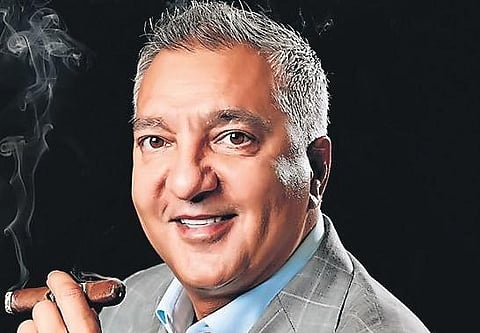

It sounds like something out of Hollywood. And indeed it is, because before he became a craftsman of cigars, Rocky Patel was a lawyer for litigious celebrities in the original Tinsel Town in the ‘80s and ‘90s. “I’d be waiting around with them on their sets, and they were all smoking cigars, and so I began smoking cigars,” says Patel, who is in Delhi to launch his now eponymous leading label.

Unlike most cases of peer pressure, which lead to a talk from one’s parents or a debilitating habit, this new fascination led Patel, and his cinematic cronies, to founding the Grand Havana Club in Los Angeles, conveniently right next to his office.
“Someone came and wanted me to invest in producing cigars with them, and soon a hobby turned into investing more than I had ever intended. Pretty soon I saw a lot of money going out, but nothing coming back in, and finally bought the other gentleman out,” recalls Patel.
Like any good second-act, Patel had to face naysayers who said he’d never succeed, especially since he wasn’t Cuban, in an industry that was passed through many generations, and that he really didn’t know anything about cigars and how they’re made.
Cue Rocky’s Eye of the Tiger theme song in your head, because this is when Patel said, “You’re, right, but I’ll learn.”
Over the next five to seven years, Patel says, “I went to Nicaragua, Honduras, and the Dominican Republic, and asked a lot of stupid questions. I started working in the farms, and in the curing and fermentation centers, learning and making thousands of blends to educate my palate.” These are the regions in which, today, Patel many of his cigars, but he notes having to source tobacco from many different regions in the world, in order for supply to keep up with the demand.
Post his exposure to the cigar-making part of selling cigars, Patel felt qualified enough to return and start making his own, implementing the strictest quality controls he had learned, and more importantly, implementing them.
“We started with three or four employees in a garage, and today we’ve got over 3,500 employees and are turning out a little more than 23 million handmade cigars a year,” says Patel.
It didn’t happen overnight. Patel began with (literally) rolling out cigars under the brand Indian Tabac, way back, “around ’96. It was in 2001-2002 that we took control of our own production, instead of having others make cigars for us, and that’s when I put my own name on the brand,” he recalls.
Initially, he didn’t sell to Europe but decided to start around 2005-06, at which point he was thrown out by several retailers in Geneva and other Swiss markets who said they had no interest in cigars made by an Indian. At that time, 90 per cent of the market was dominated by Cuban manufacturers, with Davidoff largely controlling the remaining 10.
“Today, the European market is dominated by 60 per cent ‘new world’ cigars from Central and Latin American countries apart from Cuba, which still has about 40 per cent control,” says Patel.
Incidentally, Rocky Patel Cigars boasts a collective of 3,500 labels, one of the largest in the world. He has a direct hand in about 90 per cent of the cigars manufactured under his own label, with “35-50 per cent input” in the blending of customized blends, which are requested by many, many of the customers in the 189 countries that Rocky Patel retails cigars too.
Not Just Blowing Smoke
Rocky Patel is an Indian-born Hollywood lawyer who went on to become one of the leading cigar barons in the world. And as he ever so rightfully claims, it is “all about the blending.”