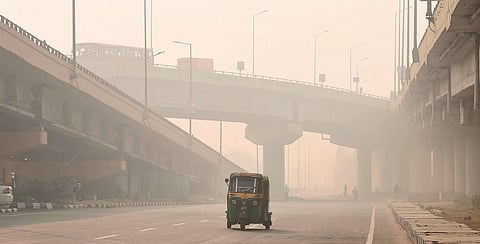

NEW DELHI: The Public Works Department (PWD) of Delhi government has prepared a decongestion plan in order to control vehicular pollution at the Anand Vihar Inter State Bus Terminal (ISBT). Under this plan, the department will widen the approach road— with 4 lanes being added to the existing 9m wide bridge for entry to the ISBT— extending it to 12m. A separate bridge is also being planned between Anand Vihar Bus Terminal to Road No. 56.
The PWD has floated tender for the project and the estimated cost of the proposed plan is Rs 5,80,83,763.
“Anand Vihar is one of the hotspots for air pollution in the capital. Surrounded by a bus terminal, metro station, UPSTRC, and Railway station, the area always remains heavily crowded and congested. The existing entry point from where the vehicles enter the ISBT will be widened to decongest the area,” a senior PWD official said.
“When the entry point will be widened, number of lanes on both sides of the road will also be increased to six. After this, buses will be able to smoothly enter the bus adda without creating traffic snarls. It will also reduce traffic on the main road in front of the Terminal,” the official said. According to a Delhi Traffic Police official, more than 1.5 lakh people use this road daily. The footfall in and around the Anand Vihar bus terminal is nearly one lakh.
The decongestion plan was formulised following the directions of Bhure Lal, the chairman of the Supreme Court-mandated Environment Pollution (Prevention and Control) Authority (EPCA). Lal has directed the PWD to decongest and make plans to combat pollution and traffic congestion in all hotspots across the national capital, said a PWD official.
Air quality improves at 13 hotspots during lockdown
Air quality in 13 pollution hotspots improved significantly due to restrictions on industrial operations and commercial and vehicular activity during the lockdown, according to the Central Pollution Control Board. Therse hotspots in the city have been identified based on PM10 and PM2.5 levels. The CPCB said it analyzed air quality data in three stages— pre-lockdown (March 1-21), lockdown phase-I (March 25-April 19) and lockdown phase-II (April 20-May 3). “Noticeable reduction in PM2.5, PM10 and NO2 levels in hotspots of Delhi was observed during the lockdown period as compared to 2019 levels,” it said
