
NEW DELHI: The track-laying activities have commenced in the underground tunnels of the Delhi section on the Delhi-Ghaziabad-Meerut RRTS corridor. In this process, the track-laying activity has commenced on both the up and down platforms of the Anand Vihar station and at present, track slabs are being laid. As this work progresses further, soon the track laying work will be carried out in the tunnels and proceed towards the New Ashok Nagar station. The construction of both parallel tunnels from Anand Vihar towards New Ashok Nagar has already been completed.
Apart from this, approximately 2 kilometres of track have been laid on the elevated section between New Ashok Nagar RAPIDX station and the underground tunnel ramp of Khichripur. A total of 5 kilometres of the track is to be laid on this elevated section between Anand Vihar and New Ashok Nagar, for both the up and down lines, out of which around 2 kilometres of track has been completed so far.
The construction of the viaduct from New Ashok Nagar towards the Khichripur ramp has already been completed, whereas the construction of the ramp, connecting the underground tunnel and the elevated section, is in its final phase. With the completion of the ramp, the underground section of the Delhi section will soon be connected to the elevated section.
It’s for the first time in the country, advanced technology is being used to produce high-strength ballastless track slabs for railways. These ballastless track slabs have a longer life span and require less maintenance, which in turn minimizes the overall maintenance cost of this track to a considerable level.
High-quality concrete is used to manufacture these 4 m x 2.4 m long slab tracks. On the trucks-trailers, these slab tracks are being brought to the site of the tunnel and the installation inside the tunnel has commenced. To provide strength to the track in the circular tunnel, firstly a PCC (Plain Cement Concrete) base is constructed.
To minimize the vibration in the tunnels caused by the movement of the high-speed trains, a mass-spring system is being used by NCRTC. In the installation process of this mass-spring system, before laying the slab tracks in the tunnels, a layer of first-level concrete is applied on the surface of the tunnel.
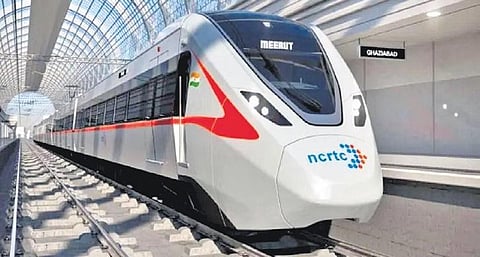
The Delhi-Meerut RRTS corridor is 82 km long and will connect Meerut to Delhi in less than an hour. The trains on this route will run at a maximum speed of 180 kmph.
