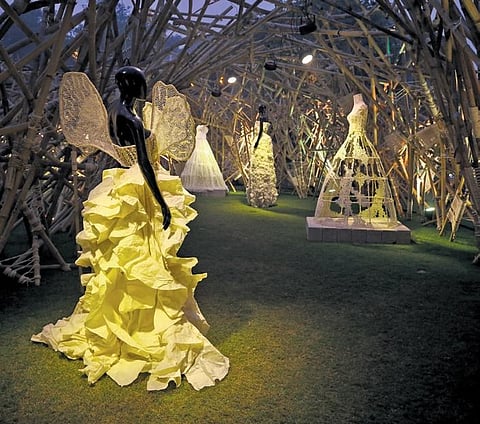

Fashion industry veteran Payal Jain’s recently held exhibition, ‘Soul of a Woman’, is an amalgamation of art and fashion and it showcases her three-decade-long journey. At the heart of the exhibition lies Jain’s philosophy— to look at fashion as a form of art with textiles as her canvas. The show displayed her ability to merge materials like metal, wood, paper and bamboo with textiles, craft, embroidery and surface ornamentation, and translate that into clothing of unique shapes, forms and colours. Excerpts from a conversation:

What inspired this exhibition?
‘Soul of a Woman’ is a retrospective of my three decades in fashion. There are 30 pieces and each one represents a year of my journey. For example, the collection ‘Forbidden Love’ was inspired by the artist Frida Kahlo. The collection talks about the life of Kahlo, the Mexican revolutionary. The collection is an ode to the painter, the magical surrealist, the feminist, the revolutionary, the lover, the lonely soul! I have been inspired by her life and work for over a decade and she resides deep in my subconscious. Fashion and art are intertwined. When I create couture, it’s about understanding the person who will adorn it, getting into their heart, mind and soul, and creating something special that speaks their language and compliments their unique personality.
When did you first realise you wanted to pursue fashion as a career?
My journey from architecture to fashion was fuelled by my passion for sketching, and my dedication to sustainability was inherited from my father. My mother’s an artist; she used to play the sitar when I was growing up. My parents told me to do a basic degree first. I got into a B. Com honours programme at JMC and in these three years, I started exploring other avenues, because I knew this was not something I wanted to pursue. I also pursued my love for sketching. Someone then suggested that I should try my hand in fashion. I started reading about fashion, made portfolios and one thing led to another. Once I had discovered my love for fashion and textiles, there was no looking back.
You studied Fashion Design at FIDM San Francisco. What were some of the most valuable things you learned there?
I believe there are aspects of both ‘art’ and ‘science’ to fashion. The ‘art’ of fashion is almost intrinsic to your personality and your creativity stems from it naturally, yet it needs direction. The ‘science’ of fashion on the other hand needs to be learned and perfected; it includes technical skills, eye to detail, precision, and perfection. My years at FIDM taught me all that I would need in my journey ahead, such as patternmaking, draping, grading, sketching, illustration, history of art, fashion marketing, visual merchandising, et cetera.
You have designed corporate uniforms for The Leela, Goa and later for over 200 hotels. How important is the cultural and regional aesthetic in creating a ‘hotel uniform’?
Couture is one end of the planet where you can literally say what you want, create what you want. When it comes to corporate uniforms, they have to be practical and functional and mindful of the brand ethos. For example, if I am doing a hotel in Bali, there are cultural nuances such as some people would want a head scarf for certain reasons, or some people will not want their ankles to show.
What were the challenges of starting your own business after returning to India?
I moved back in the early 1990s to a nascent fashion scene. Designers were treated as glorified tailors and no one understood that there was a skill and education required to pursue a career in fashion. In those days, most people were willing to spend thousands of dollars on Indian outfits, but refused to pay even 50 dollars for a well-tailored suit or immaculately draped dress. I used Indian textiles as people were very happy wearing saris and Indian clothing. There was no market for Western clothing when I started making it, however, things gradually changed.
Sustainability is now a buzzword. According to you, what does it really stand for?
We use only natural fabrics. All the garments are made of scraps that are repurposed, recycled and reused. We don’t use plastic in our premises. It is imperative for fashion designers to start using fabrics and yarns that do not simply collect somewhere and outlive us, humans. What advice would you share with an aspiring designer? The single ‘mantra’ for success is passion and love for your work — to eat, sleep, breathe, dream, and love what you do with an intensity that cannot accommodate failure. Strong technical knowledge, ability to reinvent oneself each season, the ability to take all feedback in stride, faith and positivity, willpower, and resilience are attributes that will help you survive and succeed in the fashion business.