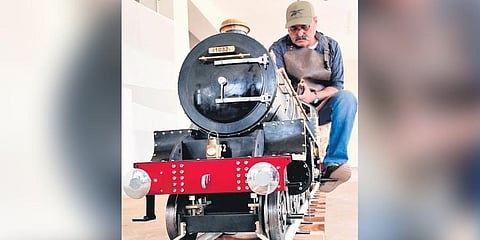

Generation Z hardly knows about steam locomotives. Those who have travelled on heritage lines up the Nilgiri (Tamil Nadu) and Darjeeling (West Bengal), do, but to most, they are the stuff of fiction -- the scarlet-coloured Hogwarts Express from the Harry Potter series or the railways in the Enid Blyton books.
Sanjay Wighmal’s fascination for steam locomotives began in childhood. Born in Punjab, Wighmal travelled to Gurugram where his father was transferred. The train that brought the family there had a steam engine, and he fell in love with it. “I love steam locomotives. It's chugging, its whistle and the fact that it can move with just coal and water simply amaze me,” he says.
But he put his passion for these machines on hold for many years as he studied to become a mechanical engineer, worked for various companies and then began his own workshop. It was only in 2017 that he decided he would pursue his hobby full-time. He stresses he was able to do so because of his family’s unconditional support.
“My family knew that I was a passionate man. When I explained to them that I wanted to pursue my hobby full-time, they supported me. My wife, Sudha, took over my business to free up my time,” Wighmal states.
But family support alone would not see this project through. Although he was confident that his engineering skills would help him pull it off, the making of Wighmal’s first locomotive took some planning. The plan was on the drawing board from 2017 to 2019 during which time, he studied how a steam locomotive could be recreated in miniature. Once he got started, the locomotive had Wighmal’s complete attention.
He says that the making of such a locomotive could take a decade. But since 2019, as he worked on it daily, without family vacations or breaks, he finished it in three and a half years. “I think it is some sort of a world record, you could check it out,” he says with a touch of pride. Wighmal’s steam locomotive is 1/8th the size of an original steam engine but it is fully functional. It runs on coal, wood and gas and employs the same mechanics as earlier steam engines.
It also has the capacity to carry 25 passengers, claims its maker. But the best part is that it is transportable. On August 15, he debuted his engine in his society in Gurugram for its residents. “They were not ready to leave the place when the ‘show’ ended. A sweet girl came up to me with a `500 note to ask for a ride. For me, it was a sense of accomplishment,” Wighmal states. Dr Hemi Soneja, who witnessed the event, said: “My daughter and I took a ride and she was thrilled. My father, who used to work in the railways, was equally amazed that such a thing could be created in miniature. It is an engineering marvel,” she said.
Steam locomotives have evolved over 200 years. Its later versions were electric. Is Wighmal going to document the evolution with his miniature creations? The engineer says he is mainly fascinated with the steam locomotives. “They are the mother locomotives. They must be preserved. People travel the world to get a glimpse of these steam locomotives. My aim is to show the general public where the majestic machine had its beginnings,” he says.
Wighmal’s creation, however, is not a replica of any steam engine that has existed in history. The finished product is nostalgia-driven, what Wighmal imagines a steam engine to be like—“I could not get access to any design [of a historical engine] so I couldn’t figure out the components. I had to use my imagination. I knew the working principle—such an engine is a product of art and engineering,” the engineer says.
With a design and size so unique, sourcing these parts, however, is difficult. So Wighmal makes his own components. All the valves, the boiler, pistons, cylinder piston rings, connecting rods and wheels are created by him. Only the pressure gauge and the twin cam lubricator have been sourced. The painting of the engine was also done by Wighmal. “I learnt automobile painting for nine months. It was only after that that I painted the locomotive myself,” he says.
Does Wighmal plan to commercialise this engine in any way? He states that he “did not make this project for business purposes” though he will file patents for the components that he has designed (His workshop provides substitutes for engineering products that are imported). Wighmal does have a plan for the future of his engines. He wants to create a park that will showcase his engineered locomotives. While he has only made one now, there is a fleet in the pipeline. The cost of the land for the dream park and the transportation of the engines have halted his plans—for now.
Wighmal’s hobby is a rare one. Various reports have highlighted how the diverse steam locomotives of India either lie abandoned—even though Indian Railways has made excellent engines—or are taken to Europe, where they are studied, renovated and used. The number of railway engine enthusiasts in India is low. Wighmal, however, remains busy in his workshop. Trying to create a fleet, he’s pushing full steam ahead!