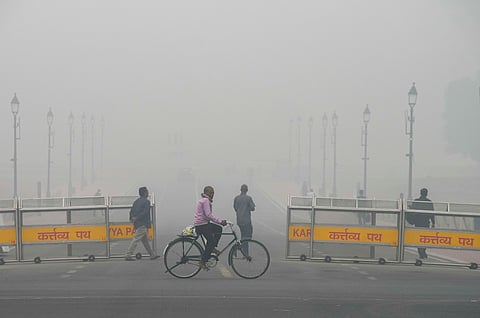

NEW DELHI: A hyperlocal analysis of Delhi’s November pollution shows a much higher level of PM 2.5 air pollution than what it is being shown by the Central Pollution Control Board (CPCB). Moreover, the analysis also highlighted pollution trends across ten major cities in India using hyperlocal monitoring techniques from November 2024.
According to the CPCB data, based on 38 monitoring stations, an average of 248 micrograms per cubic meter (µg/m3) of PM2.5 in the month of November. Further, the president's Estate doesn’t feature in the top polluted spot on the list.
However, hyperlocal analysis of different hotspots revealed that the Chandpur Village, northwest Delhi was the highest polluted area at 391 µg/m3, followed by President’s Estate in central Delhi at 385 μg/m3 and Bavana at 373 μg/m3.
“The granular analysis using Google Maps AQ data and CPCB monitoring data show the area near the President’s Estate as a hotspot, however, the government monitoring network does not have this area within the top 5 in Delhi,” says Kevin Joshi a Data Analyst at Respirer Living Sciences (RLS), a leading climate-tech startup in India.
The analysis focuses on data at approximately a 3x3 km grid or finer, comparing commonalities and differences in hotspot detection.
RLS brought a new report titled "Decoding Urban Air: Hyperlocal Insights into PM2.5 Pollution Across Indian Metropolises", which provides a comprehensive analysis of air quality across 10 major Indian cities, including hyperlocal insights into pollution hotspots.
Experts say hyperlocal air quality monitoring bridges the gap between traditional broad-scale assessments and the localised realities of air pollution.
“By providing fine-grained, real-time data, this approach enables us to pinpoint pollution sources with accuracy and design targeted interventions that can improve public health outcomes,” said Prof. SN Tripathi, Chair, Steering Committee, National Clean Air Programme (NCAP) and Dean, Kotak School of Sustainability, IIT Kanpur.
According to a report, Mumbai recorded moderate pollution, with hotspots like Shivaji Nagar and Kandivali exceeding 100 µg/m³ due to construction dust and waste processing.
Moreover, Kolkata and Patna showed significant seasonal impacts, with crop residue burning and older transport infrastructure contributing to elevated PM2.5 levels in Sealdah and Samanpura.
However, Bengaluru and Chennai reported relatively cleaner air but localised spikes in areas like Peenya and Manali due to industrial activities and traffic corridors.
Cities such as Pune, Pimpri-Chinchwad, Hyderabad, and Chandigarh revealed critical hotspots tied to rapid urbanisation or construction, insufficient green buffers, and industrial activities.
