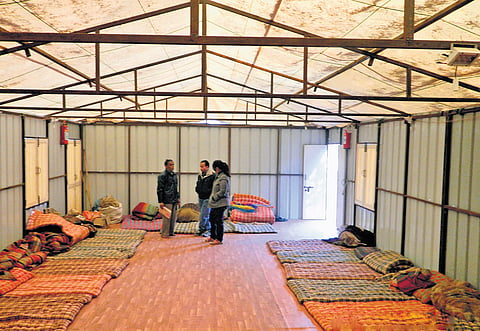

NEW DELHI: As peak winter approaches, authorities and NGOs in the capital are gearing up to provide shelter to thousands of destitute.
The Delhi Urban Shelter Improvement Board (DUSIB), the nodal agency for improving the quality of the life of slum dwellers, recently announced that it has installed 235 pagoda tents across the city to provide refuge to homeless individuals during the harsh winter nights, as part of the Delhi government’s 2024-25 winter action plan. Launched on November 15, the plan includes the setup of 250 tents, with the remaining 15 reserved for emergencies.
However, in the past, DUSIB shelters have proven to be inadequate in providing housing to all of the city’s homeless. The last official survey by the agency was conducted in 2014 and estimated a total of 16,670 homeless individuals. NGOs say that the real figure is far higher.
According to the Centre for Holistic Development (CHD), 180 homeless people died as a result of the cold last winter. The organisation also claimed that at least 192 homeless people succumbed to the heatwave in June this year. The National Human Rights Commission (NHRC) had even issued a notice to the Delhi government on the basis of the report.
In November, the Delhi High Court instructed the Chief Secretary and other authorities to swiftly act on a plea seeking a detailed survey of the homeless population in Delhi. The court also called for an assessment of the effectiveness of existing shelter home services, ensuring compliance with legal standards.
Similarly, the apex court sought details from the DUSIB on the facilities available for housing the homeless in the city, considering the approaching winter months.
“We are concerned. We are on the eve of what is going to be a very chilly winter,” a top court bench, led by Justice B R Gavai and Justice V Viswanathan had observed.
DUSIB currently operates 197 shelters with a capacity for 7,092 individuals. Appearing for one of the petitioners, advocate Prashant Bhushan said the total capacity of shelter homes in Delhi was around 17,000 people and the DUSIB has demolished nine such facilities.

In an interview with Nitesh Kumar, Program Coordinator of the Society for Promotion of Youth and Masses (SPYM), Prabhat Shukla discusses the process and challenges in countering homelessness. Excerpts.
How many such shelters does your organisation run in Delhi?
In winter, we increase the number of homeless shelters in operation. We currently have about 75 such shelters in the capital with a daily footfall of 200. In addition, we operate five de-addiction shelters since a majority of the homeless population are drug addicts. We also run recovery shelters that cater to the sick homeless.
How are these shelters operated?
The footfall increases in winter. DUSIB has hired siven agencies that operate homeless shelters in 15 clusters. We set up homes wherever we feel the requirement for shelter. Each cluster also has a rescue team and van which transports willing people to nearby shelters. We also try to set up temporary shelters in areas with a substantial homeless population that is unwilling to move. There are also instances of overcrowding.
What facilities do you provide at the shelters? Do you receive support from the government?
At the shelters, we provide beds, blankets and water alongside breakfast, lunch and dinner. This is fully funded by the Delhi government. We also receive some help from members of civil society. During the winter, we appeal to people to contribute items like clothing and many individuals oblige.
What would make your job easier and more effective?
We would like to appeal to the public to refrain from donating to homeless people on roadsides but rather donate to the shelters directly. When people offer blankets, food or cash on the roads, the homeless tend to continue staying on the roads rather than seek shelter at a home. Often times items such as blankets are sold in the market for money which is then used to buy drugs.
Any steps to permanently eradicate homelessness?
We also try to rehabilitate some of the homeless by providing jobs. Many of those working in our shelters used to be homeless themselves. But things are moving slowly in this direction.