
Industry veteran Tanuja Chandra made her directorial debut in 1998 with Dushman. The movie, starring Kajol, received critical praise and performed moderately well at the box office. She also co-wrote the screenplay for Yash Chopra’s Dil Toh Pagal Hai and collaborated with Mahesh Bhatt in writing the screenplay of Zakhm.
Best known for women-centric movies—her “abiding passion” —she has directed films such as Dushman, Sangharsh, Qarib Qarib Single and Sur, with prominent roles for women.
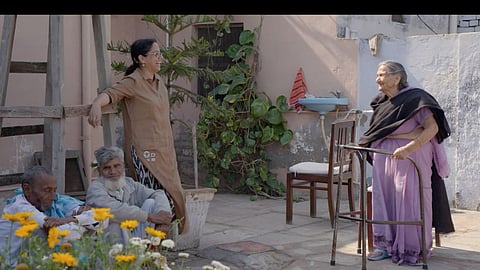
Along with films and TV series, Chandra also makes documentaries. Scheduled to release on the OTT platform, Open Theatre, on June 14, her documentary film Aunty Sudha Aunty Radha emerges as a poignant reminder of the enduring power of familial bonds. Set in the village of Lahra, near the small town of Hathras in Uttar Pradesh around 200 km from Delhi, the film provides an intimate glimpse into the lives of two aged women, Sudha and Radha, and focuses on the nuances of everyday existence.
The documentary has garnered recognition at prestigious film festivals, including the Madrid International Film Festival, the Chicago South Asian Film Festival, and received awards at the 10th Dada Saheb Phalke Film Festival and the 9th Kolkata International Short Film Festival, among others. Excerpts from theconversation:
With Aunty Sudha Aunty Radha, you have crafted a sensitive and insightful portrait of aunts. What was the inspiration and what was your biggest takeaway from this experience?
I made it on my Buas, who I was always inspired by because they were vibrant, funny, and smart women. I would always be quite enchanted by their stories. Audiences are invited into the world of Sudha and Radha, where the rhythm of daily life is punctuated by playful banter, shared laughter, and unwavering support. This film is about sisters in the absolute autumn of their lives, facing their mortality with a surprising lightness. The deep affection between them and their caretakers, a most unusual yet quirky bond, will evoke laughter and warmth in equal measure. They retired to the village to live as they wanted to have their own independent life. I also felt that the audience would relate to it as we all have a special bond with our grandparents, aunts or uncles.

The docuseries Wedding.con chronicles the rising threat of matrimonial website scams. Many women are duped of large sums of money through matrimonial fraud. Why do you think women fall into such traps? How did you zero in on the women who feature in your documentary?
When three years ago this project was first pitched to me, I was shocked to know the spread of the crime. Women, who are the victims, are very often made to feel ashamed for what they went through as if they are the perpetrators. I wanted to question society, which, to begin with, puts so much stress on marriage. I feel it’s always left to the woman to defend herself. The documentary is not just about the scam, it is about our society, mindset and culture. The film has come about through a process of long research as well as a dialogue by my producers with the victims. There is so little in terms of news or archival material or even statistics on this subject. So, to locate the victims was not easy. We decided on our participants based on the variations in their age, the communities they belong to, the different parts of the country they come from, and the individual cons perpetrated on them that illustrated the varying modus operandi of the perpetrators.
Don’t you feel that the situation of women directors and writers in the Indian film industry is far from satisfactory? As a country, we may be progressing in some areas, yet we still see regressive portrayals of women in our films. The reason?
When I started working three decades ago, there were just a handful of women directors. Over the years, the number has gone up to maybe 50 more—this is still a small number. Women’s presence on screen as well as behind the screen, has increased but it has not increased at the rate it should have in 30 years. There needs to be many more women directors and storytellers, and many more stories revolving around women. OTT has, however, given a significant place to women. My passion has always been to tell stories of women. It’s only since the past couple of decades that stories based on women have started becoming a little bit more popular. So, once we do it, more fresh stories will come, more unusual stories will happen. I believe if a woman tells a story, its quality will be different.
Aunty Sudha… has won many prestigious awards. As the film is now getting released on OTT as well, it will now reach a bigger audience.
As a director, the most important thing is for the film to be seen. You feel excited as a filmmaker, and now it’s getting streamed on various platforms across the world. For me, it is important that the documentary be seen in India.
You have also written a short story collection, Bijnis Woman It is a collection of stories that deal with ordinary people and ordinary lives. However, these are people with unique qualities. While writing
the book, I felt affection for even the most difficult or flawed character. Many of these stories have female characters but there are unusual male protagonists, too. Some of the stories talk about the perseverance of women in difficult situations.