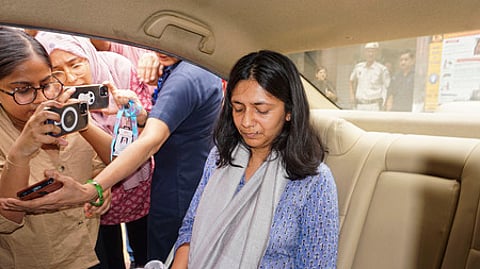

AAP leader and Member of Parliament Swati Maliwal episode would not go down in the annals of Indian history not merely as acase of political fracas but a larger social issue specially pertaining to the empowerment of women. More confounding than the incident was,first the delay in filing of the complaint by the victim, and thereafter the release of the videos of the incident in the public domain.
In the realm of the studies in social exclusion there are three very mortifying elements – Silence, Silencing and Shame. It collectively contribute to the marginalization and disenfranchisement of affected individuals.
Social scientists say that silence emanates when the voices and experiences of the victims are frequently overlooked or ignored. This neglect can make those who are excluded feel that their perspectives are neither valued nor welcomed. This enforced quietness stifles individual expression and leads to marginalization.
Silencingis distinct from silence. Sociologists define silencing as an active process employed by dominant groups to suppress the voices of the marginalized. This can occur through censorship, intimidation, and cultural erasure. Silencing maintains power dynamics by ensuring that dissenting voices remain unheard.
Lastly, Shame, which the social scientists say is an emotional response.When individuals perceive themselves as fundamentally unworthy due to their exclusion, they may experience deep-seated shame.
The interplay of shame and social exclusion is particularly evident in contexts where societal norms and values devalue certain identities or experiences. Swati Maliwal case initially underscored the aforementioned social premise. However, the events thereafter may tell a different story.
On May 13, the police had received a call from a woman who identified herself as Rajya Sabha member Swati Maliwal and alleged physical assault at the residence of Delhi CM Arvind Kejriwal by his close aide Bibhav Kumar. Soon after the call, Maliwal visited the Civil Lines police station but did not lodge a formal complaint.
Two days after the incident, the Delhi police filed an FIR against Bibhav booking him under IPC sections pertaining to assault, criminal intimidation, and outraging a woman’s modesty, based on purportedly on a statement by Swati Maliwal, a Rajya Sabha member and also former head of Delhi Commission for Women (DCW). Before the filing of the case, Maliwal took to micro-blogging site X to confirm that she has given a statement to the police.
In the statement she said, “Consequential elections are under way in the country. Swati Maliwal is not important; the nation’s issues are more important. A special request to those from BJP — please do not politicise the incident.”However, her own party has called her a BJP stooge.
Delhi Minister, Atishi, soon after the FIR was lodged, said, “Ever since Arvind Kejriwal has got bail, the BJP is rattled. The BJP hatched a conspiracy, under which Swati Maliwal was sent to Arvind Kejriwal’s house on the morning of May 13. Swati Maliwal was the face and pawn of this conspiracy.”
This has added a lot of grist to the tale. Atishi’s statement on the face of it, may look like an attempt at silencing. While Maliwal’s silence for the two days was bewildering, the attempt at ‘silencing’ is perplexing.
Maliwal remained a prominent face of the party till the deplorable fracas was reported in public. She and so also her Rajya Sabha colleague Raghav Chadha, have been conspicuous by their absence from the public domain during the period Kejriwal was behind the bars.
However, does the anger of party leadership with them invite this kind of display of raw power, if any used? With the arrest of accused Bibhav the matter in the social media may come to a rest for a while but the issue at large would continue to haunt. While AAP cadres and leaders have set new records of lows in political discourse, this time around they are damaging the whole idea of women empowerment.
