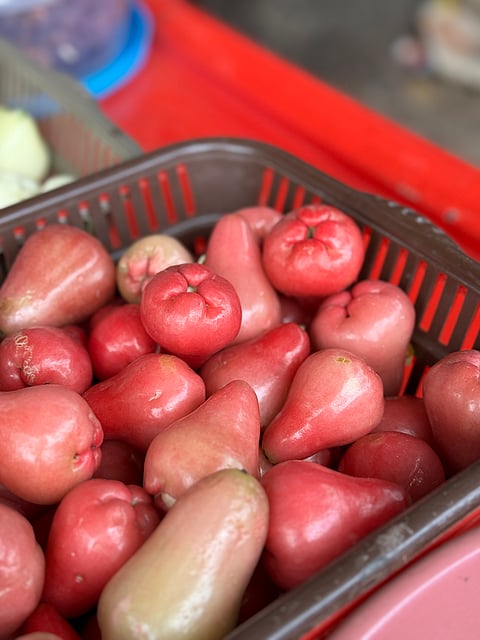

To escape the unforgiving heatwave in Delhi, I have sought shade and respite in Mumbai this week, only to find myself in a city that comes close to the feeling of being in a steam sauna, owing to the excessive humidity that is being caused because of the summer heat and the approaching monsoon. Even then, I must be honest—the heat couldn’t keep me away from the local markets and experiences that the city has to offer. Having grown up in Mumbai, I find myself walking down a path of deep nostalgia where a memory greets me at every turn. Near my alma mater I found the o l d m a n who would sit outside with a variety of summer snacks like raw mango, tart carambolas, berries like karonda, jamun and the jam phal, but this time I noticed to my surprise that he also had a basket full of phalsa. Now phalsa isn’t something that is native to this part of the country, while it is found in abundance in the north of India.

My summer holidays would be spent at my grandparent’s place in Punjab and Delhi and there were sights and sounds of these holidays which made them so unique and special. One that stands out till today is “khatte-meethe phalse le lo” - the call of the phalse-wallah who would come in the late noon with a basket of phalse atop his head and sell them in paper cones sprinkled with black salt. Phalsa is indigenous to India and is commercially cultivated in Punjab and parts of North India. The scientific name for these sweet and sour berries is Grewia Asiatica.
I hurriedly asked him to pack some to make phalse ka sherbet. Usually I’d have the phalsa just as is with some black salt, but making a sherbet with these berries is another very common way of preserving and consuming them, and after having found them in Mumbai for the first time, I wanted to preserve the flavours for my phalsa-starved family.
In the tiny but vibrant bylanes of Bandra in Mumbai’s western suburbs, I met my friend and wellness food consultant - Amrita Rana, who had very thoughtfully prepared a meal for me using jowar daliya, jamun glazed mushrooms, plump cherry tomatoes, some summer greens and lacto-fermented karondas. The Buddha bowl that she put together for me was a blast of summer specials in a bowl and a wholesome meal. I shared with her about my recent discovery of the berries in Mumbai and she instantly made the plan to pick some and use it in her food experiments. One of her most successful and viral experiments has been t h e j a m u n rawa cake.
In my housing complex in Mumbai that is surr o u n d e d with lush scarlet gulm o h a r trees, also stands an old jamun tree which has seen its surroundings evolve over the years. As kids we would pick the fallen jamuns from the tree and get them home and soak them in water and later have it with black salt. Our tongues would be stained violet and the thrill of that is unparalleled even today. You see, the thing with food is that it is not just about the simple act of eating. The beauty of food often lies in the memories.
In Delhi, my house has a karonda tree nearby and I often pick those karondas to add them into subzis. Anita Tikkoo, a resident of Swastha Vihar in East Delhi, makes a delicious tart karonda pickle, which is a personal favourite and I love pairing it with a simple namak-ajwain paratha. Probably the only delight that the summer months bring for some of us are the variety of fruits and berries that flood the markets. In today’s age of social media even ingredients have a following, which would probably explain how the phalsa reached Mumbai too to try its luck?