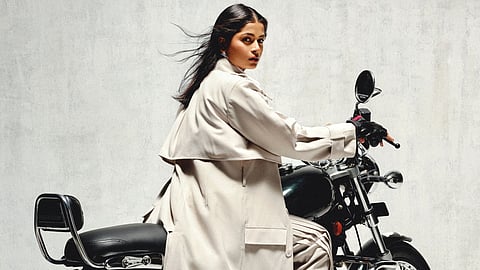

Recently, India emerged victorious against Pakistan in a high-stakes match at the ongoing ICC Women’s T20 World Cup 2024, being held in Dubai till October 20.
While the cricket icons Jemimah Rodrigues, Shafali Verma, Shreyanka Patil, and Radha Yadav bowled the audience with their on-field performance, they can equally make a statement with their style sense.
The four sportswomen were roped in for an interesting fashion campaign by Delhi-based label Qua to launch their new collection ‘Modern Heroine.’
The campaign is themed around women who are unapologetically themselves, who push limits, and redefine what it means to be powerful in a world that often demands conformity.
For Qua, whose past collections like ‘Alpha’ which spotlighted feminine power, ‘Chase’ which was about the pursuit of dreams and ‘Pure Ambition’ was about striving for self-actualisation, it’s no wonder that ‘Modern Heroine’ continues with the label’s philosophy — to “empower today’s women” through what its founders call “modern armour”.
TMS talks to the women behind Qua — CEO Rupanshi Agarwal and creative director Divya Agarwal. They deconstruct the cricket-themed campaign that showcases the multi-dimensional personality of women who embrace both masculine traits as much as they exude feminine allure. The co-founders felt that cricket, being one of the most widely followed sports in India, allows this collaboration to make a bold statement.

Cricket as inspiration
“The collaboration between Qua and these remarkable women cricketers came about as a natural alignment of values, vision, and timing. Qua has always been dedicated to empowering women through power dressing that reflects modern women’s strength, resilience, and confidence. As a women-led brand, we wanted to connect with women who not only embodied these traits but also represented a larger cultural movement of women breaking barriers. Collaborating with female cricketers seemed organic,” says Rupanshi on the campaign about power- dressing adding, “The timing of the campaign, with the ongoing T20 World Cup 2024, made the partnership even more relevant.”
Evolution of power dressing
Power dressing is often described as a strategic way of dressing to influence how others perceive you and also, to an extent, how you perceive yourself. The choice of outfits hence is often the one that conveys confidence, competence, authority and professionalism. The concept became popular in the 1970s and 80s when many women started to enter the workforce especially in male-dominated fields like politics and business.
However, the concept is said to have found its roots in Europe — in the tweed power suits introduced by French fashion designer Coco Chanel in 1925, and ‘power shoulders’ popularised by Italian fashion designer Elsa Schiaparelli in the 1930s.
Later in 1966, YSL created a power suit with trousers for women where a man’s tuxedo was imagined to fit a woman’s body as a marker of her breaking gender barriers. But in the years after the 1980s, the concept took a progressive turn with ‘soft power dressing’.
It meant doing away with essentially a male wardrobe of tailored suits with trousers, jackets with shoulder padding, and wearing greys and blacks to opt for soft-structured outfits, muted shades and even colourful tones, bold accessories, and relaxed silhouettes like silk, satin and cotton in tailoring.
Qua’s latest collection emphasises this evolved language of power dressing. Rupanshi believes that it has become a “non-negotiable” for today’s women. “Today’s woman is particular about how she presents herself. Each piece she wears is intentional, contributing to a larger narrative about who she is and where she’s headed.
Power dressing gives her control over that narrative, influencing how others perceive her and, more importantly, how she perceives herself. It fuels her confidence and has become a tool in her journey toward success,” she says.
For the contemporary woman
Attuned to the idea, the sports stars are seen donning power dressing outfits like trench coats, tuxedos, double-breasted blazers, blazer dresses, flared maxi skirts and fluted dresses. However, Divya shares that the label has redefined the concept by balancing masculine styles with feminine grace. “Masculine tailoring is softened by feminine silhouettes — whether it’s a structured blazer paired with a flared skirt or a trench-inspired dress that merges sharp lines with gentle curves.
One can also see double-breasted blazers and blazer dresses featuring sharp shoulders balanced by soft shaping through the body. Thoughtfully placed panelling that creates a contoured shape in a burnt terra waistcoat blossoms into animated hemlines in flared maxi skirts and fluted dresses. This interplay of strength and softness, formality and ease, defines the collection,” Divya tells TMS.
Similarly, the colour palette also observes a meld of deep and soft shades. From midnight blue, obsidian black, and gunmetal gray, to warm tones of terracotta and tobacco, they offer an understated yet luxurious look.
The pieces are not just bold but functional too. Divya highlights some utilitarian styles that can be worn on multiple occasions. “The sculpted double-breasted tux dress paired with a crisp white shirt and faux leather tie brings a refined sharpness to occasionwear.
Meanwhile, the transitional trench coat matched with a double-breasted suit speaks to functionality and style, creating a sleek ensemble perfect for both professional and after-hours. The flared panelled skirt, cut in a floor-skimming length, will make one feel empowered and contemporary,” she says, adding that each piece marks a shift from traditional power dressing to something more “dynamic” and “progressive.”