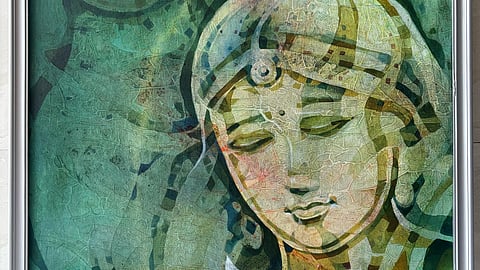

“‘Peace’ has shifted from a personal longing to a shared, universal state,” says artist Bhaskar Singha about the fifth edition of his solo exhibition series ‘Realms of Peace – V’ that was held last week at Delhi’s India Habitat Centre. Singha began the series in 2019; he initially painted “tranquility as escape.” “Now, I see peace as active engagement, embracing chaos, accepting imperfections, and finding harmony within diversity. It’s less stillness, more a compassionate presence in the world,” he says.
Singha’s artistic journey spans nearly three decades, rooted in Indian philosophy and contemporary socio-cultural narratives. This year, his works explore “inner silence amidst relentless noise”. He explains, “Philosophically, it grew from the Sanatan concept of shanti — peace as dynamic balance. Emotionally, it stemmed from witnessing resilience in people’s daily struggles, inspiring works that celebrate quiet strength rather than passive calm.”

Initially known for watercolours, Singha later transitioned to acrylic on canvas while retaining the meditative softness of his earlier work. “Acrylics gave me greater texture and depth, yet I preserved watercolour’s luminous transparency and fluid movement. That sense of breathing space and openness for viewers’ interpretations remains central to my language,” he explains.
His canvases blend everyday life with spiritual and philosophical ideas, touching on child labour, psychological unrest, and Sanatan philosophy. This edition also addresses contemporary realities subtly. “While the imagery is meditative, undercurrents reflect today’s anxieties: displacement, climate change, fractured communities. I weave these through fragmented forms and disrupted rhythms, yet hold them within a framework of hope, suggesting peace requires acknowledging — not ignoring — our present challenges,” he says.
Through gestures like the breeze on a beach or a solitary runner in a Clean India campaign, he evokes motion, stillness, and transformation. Works such as ‘Youth’, ‘Maa Sarodha’, and tributes to Tagore, Vivekananda, and Satyajit Ray exemplify his balance of realism, emotion, and philosophy. “Daily gestures can hold the same spiritual energy as prayer. In my canvases, ordinary acts coexist with philosophical imagery, reminding us that the sacred lives quietly in our routines.”
Asked how he translates vast philosophical ideas into visual form, Singha says, “I distill them into symbolic forms — lotus blooms, flowing rivers, open skies — while respecting their layered meanings. Minimal but deliberate details invite viewers’ own associations. The aim is curiosity and contemplation, not full explanation.”
Having exhibited across major Indian cities, Singha remains excited about painting. “The canvas remains a space of discovery. Colours surprise me, mistakes open unexpected paths. Painting is my meditation, my dialogue with time.”
Asked about a sixth edition, he adds, “The journey isn’t finished. I’m curious about peace within conflict, or joy as resistance. Whether the title changes or not, the essence remains an ongoing search for harmony through colour, form, and layered meaning.”