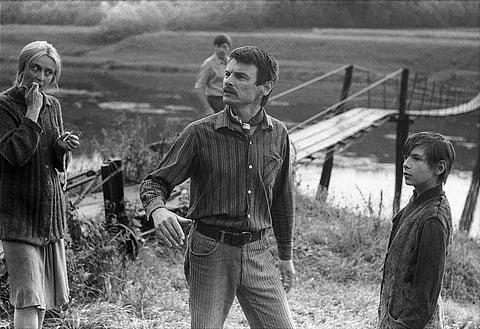

Chapter 1 of Andrey A Tarkovsky’s film on his father Andrei Tarkovsky, one of the greatest auteurs of cinema, begins with the filmmaker himself. Sunlight falls on an old photograph of Andrey’s boyhood, then moves on to another boy—his father as a child sitting under the sun with a book. Next, that boy is shown walking beside a man—Andrey's grandfather—unsteady at first, then standing without help.
Andrey Tarkovsky: A Cinema Prayer, made with unseen footage, photographs and drawings, is that rare film, which captures Andrei Tarkovsky’s fundamental and complex relationships with his two estranged fathers, the famous Russian poet Arseny Tarkovsky and the Soviet state. It is paved with the unsoothing, uncanny poetry of Arseny Tarkovsky.

“By the jasmine lies a stone/Beneath the stone lies a treasure/On the path stands father/It’s a bright, bright day….”
Andrey is in Delhi for a brief visit. The screening of the film— it has premiered at the Venice Film Festival— organised by the Italian Embassy Cultural Centre, is being shown in India for the first time. It is set to tour other cities of the country. Cinema Prayer is a film of a son’s search for his father when he is no more, through things said or found in archives to renew a dialogue with him that was interrupted. Andrey was only 16 when Tarkovsky died of cancer.
“The film is a rebuilding of the history of his cinematic experience, but is also of a son who tries to understand the relationship of his father with his grandfather, through the work of his father”, says Andrea Anastasio, director, Italian Cultural Institute, Delhi.
From Ivan’s Childhood (1962) to Sacrifice (1986), Andrei Tarkovsky’s seven features were testimonies to his invention of a new cinematic language, films built like paintings that drew from memory and nature, moving with hope and spirituality in directions where there may be none.
Andrey runs The Tarkovsky Institute in Florence, Italy.
Excerpts from a conversation:
You are the son of Andrei Tarkovsky. How big and heavy a responsibility is it?
It’s not a burden, it’s a legacy that I think is important to promote and to go forward with because he was a great artist. He was a poet, but also a teacher and, in some ways, a prophet, as all great artists are. Yes, it is a responsibility, but it is also a great way to understand his life and to share his ideas with the world. He died very young. He was just 54.
You were born when Tarkovsky was shooting Solaris….
Yes. I was born in 1970. Solaris came out in 1972. I was two years old; there is one picture of me in the film.
What are you doing in the film?
I was just a picture on the wall in the lab of Dr. Sartorius. He just put me there, I think, thinking of me and of his newborn son. It was just a small memento for himself, and it appears in the scene of the dialogue between Kris and Dr Sartorius in his laboratory.
Why did Tarkovsky leave the Soviet Union and go into exile?
His artistic life was very complicated. It was a continuous struggle against the censorship. His spiritual search was going against the social realism of the official artistic direction that the Soviet Union had. But he was a very powerful artist. He still made five films, but only five in the last 22 years.
Obstacles were created to his work. That means not being able to talk, to communicate and to show his work. So, he asked for three years of working abroad, just a permit, for shooting Nostalgia in Italy. Then he wanted to go back, and they didn’t allow that. They kept me in Russia as some kind of a hostage for four years.
After the film came out, and after the attempt was made to sabotage the film at Cannes, that was the moment he understood that if he goes back, he won’t get to work anymore. So, it was a very difficult choice. Not to see his family, but just to remain outside for work. But it was the right choice, because after that he shot Sacrifice.
Would he bring work home?
His life and work were the same thing. His work was communicating at home with people about his ideas, about his vision, about his research, his spiritual research. He would do meditation, yoga, he was trying to create a syncretic system between western and eastern cultures. He was always in search of truth. That was the most important thing for him, more than cinema itself. Just the research for the fundamental questions of our life and for a spiritual development of himself and of his audience.
While it is said that his films are a part of the aesthetic and spiritual traditions of Europe and Russia, they are also deeply personal films. Which, according to you, is his most personal film?
Each of my father’s films is personal. If you watch them closely, you can say maybe it is just one film divided into eight parts. There is always something of him in them. Of course, his most personal, and directly autobiographical film, which speaks about his family, his mother, his father, is Mirror. He had a very important relationship with his father, who was a great Russian poet. And it was fundamental, because without his mother and his father, and the particularities of that relationship, even its difficulties, he could not have become such a great artist. Mirror is a film that speaks very profoundly to everyone. Each person who sees this film and likes this film, thinks it is about himself.
That profundity is a special gift of Tarkovsky’s. While speaking about himself, but the sharing of it in a certain language...compassion is not only a religious term, it is an artistic choice. You can cure yourself through that, and he achieved it in his cinema. That’s his greatest gift.
Did he have a favourite among his films?
He was very critical of his work, he always thought he had not achieved for himself perfection in his films. Maybe Stalker was the film that he liked more from the others because it was more concrete, more ascetic, precise. There are no distractions. It’s only three people, their inner voyage.
He came out of the Soviet film school, the school of Eisenstein, the creator of the montage. One knows that montage eventually became a dogma, it’s the juxtaposition of opposites to produce meaning. And Tarkovsky wanted to break that, he said if you are constantly trying to look for meaning, you will actually miss what’s happening. But how did he arrive at that being a product of that school?
He had a great gift of seeing the world from a different perspective. A much larger view. And his goal was to try to put the invisible into the visible. That was his main goal. You cannot learn that. You can learn the skills of craftsmanship, of filmmaking, in a film school.
But these ideas, the profound spiritual search, I think it comes more from family heritage, from grandfather. My grandfather was a great poet, he was perhaps the last of the constellation of poets, philosophers, artists of the so-called Russian Silver Age. It was the end of the 19th century and the beginning of the 20th. The godfathers of this movement, of course, are Dostoevsky, Solovyov, Berdyaev. So, these philosophers were those who tried to create a new way of seeing life, a new way of spiritual rebirth of the people. If you want to see the genesis of Tarkovsky as an artist, a poet, you have to look there, and not especially in cinema. Yes, he chose a certain cinematic language, but with his special sensibility, he transformed cinema into something more than ideology, into a piece of art.
He is impossible to imitate. It is impossible to say 'I’m doing a film like Tarkovsky'. You cannot find a follower. You can be inspired by him, yes.
Andrey Tarkovsky: A Cinema Prayer, is to be screened Sept 16, 4pm, MMC auditorium, Cinema Paradiso Auroville/Pondicherry and at DIFF Dharamshala, Oct 30-Nov 2