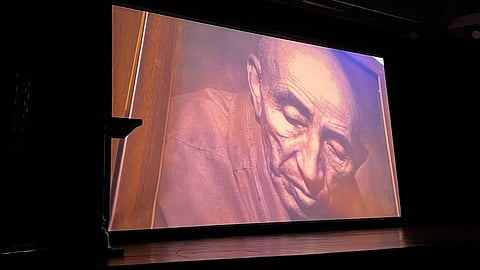

Kushok Bakula was an exemplary figure who played a significant role in India’s first war against Pakistan in 1947-48, says Hindol Sengupta, director of the film, The Extraordinary Story of an Extraordinary Monk.
A screening of the IBC (International Buddhist Confederation)-sponsored documentary, based on the life of Buddhist monk and diplomat Kushok Bakula Rinpoche, was held at the India International Centre (IIC) in New Delhi, on Wednesday.
The film features the remarkable journey of Kushok Bakula Rinpoche, a spiritual leader from Ladakh. Ngawang Lobzang Thupstan Chognor, commonly known as 19th Kushok Bakula Rinpoche, was born on May 19, 1918, in the Matho branch of the Royal House of Ladakh. He was recognised by the 13th Dalai Lama as a reincarnation of Bakula Arhat, one of the Sixteen Arhats who were direct disciples of Gautama Buddha.
From raising a Ladakhi division during the 1947-48 war against Pakistan to serving as India’s ambassador to Mongolia for ten years, where he helped revive Buddhism after decades of communist suppression, Rinpoche’s journey is full of courage and service.
The film opens with a view of the Kushok Bakula Airport in Leh, the capital of Ladakh, and quickly transitions to the region's vast, cold deserts and towering mountains. It refers to Rinpoche as a monk, a politician, and the most successful diplomat in India’s history.
Speaking about the project, director Hindol Sengupta calls the film quite a special one. “I was trained in filmmaking, and I’ve always enjoyed it, but this film was very, very close to my heart,” he remarks. “It is about a subject I find fascinating, the life of Kushok Bakula Rinpoche.”
Sengupta calls Rinpoche “an absolutely fascinating figure”. “He raised a division of young Ladakhi men to fight during the first war with Pakistan. That division later became a cutting-edge Himalayan force of the Indian Army. As a diplomat in Mongolia for ten years, he played a seminal role in reviving Buddhism there,” the filmmaker adds.
Sengupta also spoke about the challenges of filming across Ladakh and Mongolia. According to Sengupta, shooting in Mongolia was very exciting. “It’s a beautiful country,” he says, “but reaching there was difficult, as we had to travel via Istanbul.”
Additionally, the language was also a barrier. However, he mentions, “But we had incredible guides who were Buddhists themselves and helped us throughout. In Ladakh, I personally struggled with breathing due to the altitude, but the local people and monks were extremely supportive.”
The documentary also highlights Rinpoche’s recognition by leaders such as Jawaharlal Nehru, Indira Gandhi, and Atal Bihari Vajpayee for his patriotism and dedication to Ladakh.
