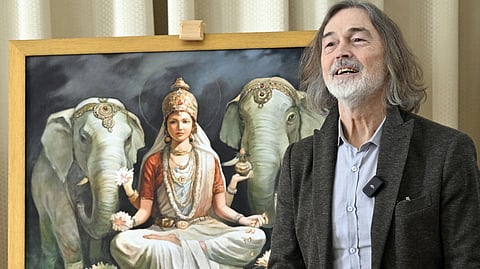

People’s Artist of Russia and Academician of the Russian Academy of Arts Nikas Safronov had clearly made art to please. In Delhi, for the launch of his exhibition, ‘Dream Vision’ made in his signature style, 100 of Safronov's finest works — many specifically created for an Indian audience such as an elephant in Russian robe or Goddess Lakshmi sitting between two bejewelled elephants — was spread across eight halls over two floors of the Lalit Kala Akademi. The exhibition is on till December 21.
Some of his unusual portraits in his distinctive style, include that of Russian President Vladimir Putin dressed in the style of [French King] Francis I (which, however, missed at the exhibition) and American actor Marilyn Monroe dressed in Elizabethan-era fashion, posed against the Hollywood sign. Safronov told TMS that his focus is mainly on capturing the character, psychology, and inner world of his subjects rather than just their outward appearance. Sometimes, symbolism helps achieve this sense of deeper portrayal, he adds. “Whether it’s a head of state who has brought major changes to their country or an ordinary person who achieved something extraordinary. What attracts me most is the story, not the status,” he says.

Early inspirations
Safronov grew up in the city of Ulyanovsk, a western Russian city. “Since childhood, I drew a lot — mostly castles and knights,” he tells TMS. At the age of 10, when he discovered a copy of French novelist Honoré de Balzac’s Droll Stories, illustrated by Gustave Doré, Safronov was so captivated by Doré’s dramatic drawings that he began copying them obsessively. Soon he was borrowing more illustrated books from the library — including François Rabelais’ Gargantua and Pantagruel and Cervantes’ Don Quixote. “At home I created my own illustrations, imagining new scenes,” he recalls.
However, even after becoming a professional artist, Safronov says he doubted whether art was truly his path — until a dream changed everything. In the dream, the artist found himself walking through an exhibition of paintings he had not made, guided by an elderly man he couldn’t recognise at first. After seeing Leonardo da Vinci in his dream, who tossed him “a glowing sphere” he woke up knowing he was meant to be an artist.
City scenes
Among the paintings he has brought to the Delhi exhibition are different cities during various seasons — the Kremlin in Easter, a spring evening in the Vatican glowing with blossoms, Venice in the heat of July, and St Petersburg in autumn. His India-inspired works include a whimsical view of the Varanasi ghats, the Taj Mahal seen from the Yamuna, the Bara Imambara in Lucknow, and more.
According to Safronov, in today’s world, digital technology is unavoidable, and rather than resisting it, artists should harness it for good. At his exhibition in Delhi, he employs multimedia projections, LED and volumetric screens, neuro-mirrors, animated paintings, and smart lighting to create an immersive experience.
From a dream
Talking about how he came up with his “Dream Vision” style, Safronov says he has painted in multiple styles since childhood — surrealism, realism, abstraction, cubism, and more. “I experimented with form, presentation, colour, and light. But, of course, many artists have done the same,” he remarks. In the ’80s, the artist visited the Italian city of Pompeii which was destroyed by the eruption of Mount Vesuvius. “The guide told us that during the eruption, a boy had fallen into a corridor of time, was unable to escape, and still cries there. I could not get those half-erased frescoes I saw in Pompeii out of my mind.” he adds.
Later, during a visit to Venice with his son, he was stunned by a view of the city’s dawn — fog hung over the water and fragments of buildings, people, and sky visible through the haze. “Remembering my earlier attempts after Pompeii, I began experimenting again — and that is how the “Dream Vision” style emerged,” he tells TMS.
Works created through this style resemble a disappearing dream. “You wake up, try to hold the dream in your memory, but it slowly melts away, leaving behind only impressions.” These impressions, Safronov adds, are what he transfers onto the canvas.
‘AI cannot replace an artist’
"Art is a form of soft power; a force capable of overcoming borders and political barriers, uniting people regardless of cultural or ideological differences,” says the artist.
Earlier in February this year, a painting depicting the Basilica of San José de Flores in Buenos Aires, was presented to Pope Francis by Safronov. It's the very church where the Pope began his pastoral service. “He [Pope Francis] began speaking to me about Russian culture and about how art can build spiritual bridges, connecting countries and peoples. Perhaps that is why Pope Francis so warmly supported the idea behind my major international project — cultural diplomacy, which uses art as an effective tool to improve international relations.”
“An artist is, in a way, a mediator — someone who connects what seems unconnectable, finds points of resonance in people’s hearts, and weaves invisible threads that allow them to share a common emotional language.”