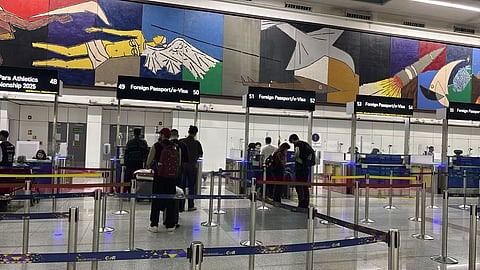

Vacation plans of hundreds of flyers were disrupted yet again as dense fog forced the cancellation of 228 domestic flights at Delhi’s Indira Gandhi International Airport (IGIA) on Monday, despite repeated assurances by airlines and the airport operator that they were prepared for low-visibility operations.
According to airport officials, 131 departing and 97 arriving domestic flights were cancelled over a nearly five-hour period as mist and dense fog reduced visibility significantly. The disruption came even though Delhi airport and most airlines had highlighted their preparedness for fog operations, citing CAT-III compliance of runways and aircraft.
The Directorate General of Civil Aviation (DGCA) has declared the period from December 10, 2025, to February 10, 2026, as the official fog season for this winter. Ahead of it, the aviation regulator had issued detailed guidelines on fog operations and asked airlines and airport operators to submit contingency plans to minimise inconvenience to passengers during adverse weather.
CAT-III compliance refers to an upgraded Instrument Landing System (ILS) that allows aircraft to land in extremely low visibility, with a Runway Visual Range (RVR) as low as 50 metres. The system provides pilots with precise radio-guided lateral and vertical approach assistance during poor visibility conditions.
By mid-September, all four runways at IGIA were certified CAT-III compliant — RW 09/27, RW 11R/29L, RW 11L/29R and RW 10/28.
However, airline officials pointed out that CAT-III capability does not eliminate all weather-related constraints. “This was the first major fog spell of the season and it was extremely dense, with visibility fluctuating between 75 and 100 metres,” a senior airline executive said. “While aircraft can land at lower visibility, take-offs require a minimum RVR of 125 metres. Since that threshold was not met, several departures had to be cancelled.”
Another aviation official said pilot availability also played a role. “Not all pilots are CAT-III trained. Although airlines plan rosters carefully for fog hours, earlier delays can push non-CAT-III-trained pilots into fog windows,” the official said, adding that such flights either get delayed, diverted or cancelled as cockpit crews are not authorised to operate in very low visibility.
The cancellations led to long queues, repeated rescheduling and mounting frustration among passengers, as Delhi once again grappled with the seasonal challenge of fog-related air traffic disruptions.