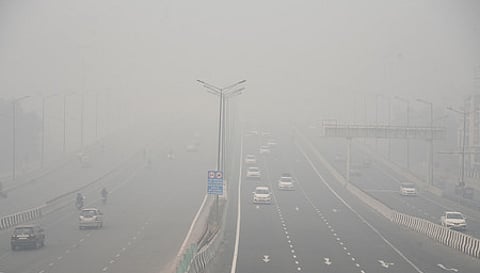

Delhi witnessed a marginal improvement in air quality on Tuesday as stronger winds and thinning fog helped pull pollution levels out of the ‘severe’ category after three consecutive days, though the overall air quality remained ‘very poor’.
The city’s 24-hour average Air Quality Index (AQI) stood at 354 at 4 pm, according to data from the Central Pollution Control Board (CPCB). Of the 39 active monitoring stations in the capital, only Mundka remained in the ‘severe’ category with an AQI of 407, while 35 stations recorded ‘very poor’ air quality and three were in the ‘poor’ range.
The Institute of Human Behaviour and Allied Sciences (IHBAS) in Dilshad Garden recorded the lowest AQI at 280, placing it at the higher end of the ‘poor’ category, CPCB data showed.
As per CPCB standards, an AQI between 0 and 50 is classified as ‘good’, 51–100 ‘satisfactory’, 101–200 ‘moderate’, 201–300 ‘poor’, 301–400 ‘very poor’ and 401–500 ‘severe’.
Data from the Decision Support System for Air Quality Management indicated that transport contributed nearly 12 per cent to Delhi’s pollution on Tuesday, followed closely by neighbouring Jhajjar at 11.9 per cent. Construction activities accounted for 1.62 per cent, while other sources together made up the largest share at 51.7 per cent. Transport emissions are projected to rise to over 16 per cent on Wednesday.
Meteorological conditions played a key role in the improvement. The India Meteorological Department (IMD) reported shallow fog across the city, marking a shift from the very dense fog seen a day earlier. Palam recorded the lowest visibility at 600 metres at 8 am, followed by 800 metres at Safdarjung, according to PTI.
An IMD official told news agency PTI that the dense fog over north India on Monday had a cascading impact on air traffic, with disruptions continuing into Tuesday despite some improvement in visibility.
Mahesh Palawat, Vice President at Skymet Meteorology, said strong westerly winds helped disperse pollutants. “Wind speeds touched 18 to 20 kmph during the afternoon and remained mostly between 10 and 12 kmph through the day. Moderate to strong winds are expected over the next two to three days, which could lead to further improvement,” he told PTI.
However, the Centre’s Air Quality Early Warning System (EWS) cautioned that the relief may be short-lived. Air quality is likely to remain in the ‘very poor’ category till Friday and may fluctuate between ‘very poor’ and ‘severe’ from December 19 onwards, PTI said.
Health experts warned that even brief exposure to such pollution levels can have serious health impacts, especially on children. Dr Medha, a paediatrician at Madhukar Rainbow Children’s Hospital, told PTI that infants are particularly vulnerable as their lungs and immune systems are still developing.
The IMD said Delhi recorded a minimum temperature of 8.3 degrees Celsius, slightly below normal, while the maximum temperature settled at 24.9 degrees Celsius, nearly two degrees above normal. Humidity levels ranged between 76 and 100 per cent during the day, PTI reported.
The weather office has forecast moderate fog for Wednesday, with maximum and minimum temperatures expected to hover around 23 degrees Celsius and 9 degrees Celsius, respectively.
Meanwhile, the BJP-led Delhi government on Tuesday said it was not possible to significantly reduce pollution levels within nine to ten months, blaming the previous Aam Aadmi Party (AAP) government for the crisis.
“It is impossible for any elected government to reduce AQI in nine to ten months. I apologise for the pollution in Delhi. We are doing better work than the dishonest AAP government and have reduced AQI levels each day,” Delhi Environment Minister Manjinder Singh Sirsa said at a press conference.
Calling pollution a “disease inherited from the AAP government”, Sirsa said the present dispensation was working to reverse years of neglect. Taking a jibe at AAP leaders who staged a protest at the Delhi Secretariat earlier in the day, he said they had failed to take effective steps when they were in power.
“They did nothing to address the issue and are now protesting over a situation they created. AQI levels have remained largely the same over the last 10 years,” he alleged.
The minister said worsening pollution posed a serious threat to children’s health but asserted that the current government had initiated concrete measures to control emissions. He also criticised Congress leaders Rahul Gandhi and Priyanka Gandhi Vadra for commenting on the issue now.
“Today, they are talking about wearing masks. Where were they when the AQI was around 380 on this day last year? They were silent then because they were supporting the AAP,” Sirsa said.
Announcing additional anti-pollution measures, Sirsa said vehicles without a valid Pollution Under Control Certificate (PUCC) would be denied fuel from Thursday. He also said only BS-VI compliant vehicles from outside Delhi would be allowed to enter the capital, while heavy penalties would be imposed on trucks carrying construction material, with violators facing seizure of vehicles.
(With inputs from PTI)
