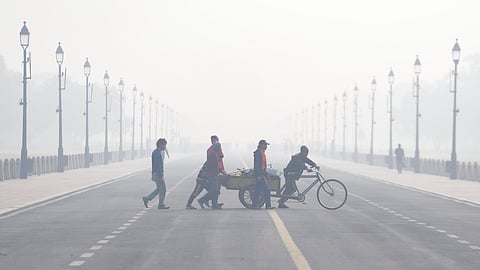

NEW DELHI: Amid worsening air quality and the enforcement of GRAP III and IV restrictions, the Delhi government on Wednesday announced a Rs 10,000 assistance for construction workers affected by the ban on construction activities, while also mandating a maximum of 50% physical attendance in all government and private offices from Thursday. The government warned that strict action will be taken against violators.
The decision follows directions issued by the Commission for Air Quality Management (CAQM) and the Delhi Environment Department to curb emissions during the ongoing pollution emergency. Delhi Labour and Employment Minister Kapil Mishra said the financial assistance for construction workers would be disbursed through Direct Benefit Transfer (DBT).
He said the Labour Department is carrying out registration and verification of workers simultaneously to ensure timely delivery of benefits. “The process is being conducted with full seriousness and capacity. As and when verification is completed, the amount will be credited directly to the beneficiaries’ bank accounts,” Mishra said.
To enforce pollution-control measures, the Labour Department has issued fresh guidelines to all government and private establishments across the capital. Under these, physical attendance at workplaces has been restricted to 50%, with the rest of the employees required to work remotely. The minister clarified that the restrictions will not apply to essential services.
These include hospitals and healthcare services, fire and emergency services, prisons, public transport, electricity supply, pollution control agencies, the Forest Department and the Delhi Jal Board. Mishra urged offices and institutions to adopt additional mitigation steps, including flexible working hours, promotion of carpooling and reduced use of private vehicles.
He stressed that compliance with the guidelines is mandatory and warned that violations would attract action under Sections 15 and 16 of the Environment Protection Act, 1986.
Launching a sharp attack on the previous governments, Mishra said the present pollution crisis was the result of prolonged neglect. He alleged that earlier administrations failed to take sustained action on road maintenance, dust control and urban cleanliness.
“The dust, broken roads, potholes and lack of green cover across Delhi are not developments of the last few months but the outcome of over a decade of inaction,” he said. He further claimed that footpaths were neglected, roads were not repaired adequately and environmental planning remained weak during the previous regime, aggravating the city’s pollution burden. “The crisis we are dealing with today has been inherited,” the minister said. “We are committed to taking all necessary measures to protect public health,” he said.
Delhi Metro a major player in protecting environment
Chief Minister Rekha Gupta on Wednesday said the Metro has brought a major revolution in protecting the environment at a time when lakhs of vehicles, including many without pollution under control certificates, are emitting smoke on the city’s roads.
The CM made these remarks at the inauguration of a Metro Museum at the Supreme Court Metro station. Gupta said nearly three crore people live in Delhi, and in such a situation, the availability of Metro-like transportation is a very big revolution for saving the environment. At present, around 3,500 Delhi government buses have been converted to electric vehicles, Gupta said.
