
Karaikkal Ammaiyar was a sixth-century Tamil poet and one of the pioneering voices of the Bhakti movement, known for her intense devotion to Lord Shiva. Legend has it that she walked upside-down to Mount Kailash, the celestial abode of the deity, as an act of devotion.
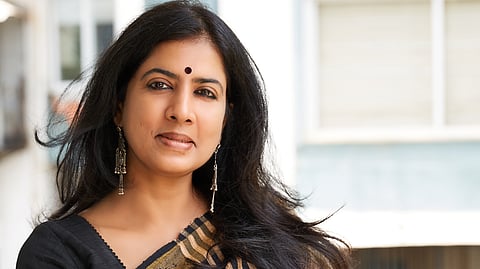
This image inspired the idea of “upside-downness” in poet and writer Arundhati Subramaniam’s latest poetry collection, The Gallery of Upside-Down Women (Penguin). The title, she explains, has been taken from the tale of Karaikkal and the radical life choices made by women mystics across time.
Alongside Karaikkal, the book features other figures such as Lakshminkara, “the relatively unknown tantric teacher who feigns madness”; Shenkottai Avudai Akkal, “a child widow who breaks out of a cloistered orthodox life to question religious norms”; and Amrapali, the courtesan-turned-Buddhist nun, among others.
According to the poet, they are women who have turned the status quo upside down; their very presence "is a reproach to staid, lukewarm ways of living", she tells TMS. In doing so, they unsettle conventional divisions between flesh and spirit, the sacred and the profane, the body and what lies beyond it.
Subramaniam adds that these women remind us that there are many ways to live — “with spirit, with depth, with laughter, with guile". "They’re actually the right side up,” the poet adds.
Apart from talking about the gallery of women mystics, the book also pays tributes to poet friends Subramaniam has lost in recent years, including Scottish writer John Burnside, and Indian poets Mangalesh Dabral and Tarannum Riyaz. The collection also discusses perennial themes of love, ageing, power, death, politics, apocalypse, and what the poet describes as an “end of quest”.
Written in metaphors
Many of the figures in the book have been inspired from real life, though they take on new meanings once they enter a certain verse. For instance, Subramaniam speaks of a tailor from her neighbourhood, a woman walking back to her village in Telangana, and even a woman in a yellow sari outside the Taj Mahal — the last inspired by an Air India advertisement.
The tailor, she says, is drawn from the familiar neighbourhood figure whose disappearance unsettled the rhythm of the neighbourhood. His steady labour has been used as a metaphor for awakening and karma yoga, and even for the “Indian ability” to endure repeated destruction. “His stoic ability to ‘darn black holes’ also makes him emblematic of a kind of hope,” she says.
Subramaniam’s love for free verse is evident throughout the collection. She describes it as something that provides an “unpredictable mix of rigour and freedom” to her work.
In some poems she has played with rhyme, staccato rhythms, and even rap-like cadences, giving each piece a distinct texture and pace.
Subramaniam stresses that she does not equate the sacred with solemnity. When the long-dead women mystics speak casually and conversationally in her poems, they are bound by a “living sisterhood.” As she notes through Avvaiyar’s words in one poem, readers are reminded to “beware of those who have never found a washing machine manual beside an Upanishad!”

Amplifying sacred voices
The new book also marks the culmination of a long engagement with accounts of women mystics she’s written about, in her earlier books, Wild Women and Women Who Wear Only Themselves. Subramaniam calls herself an “omnivorous reader of sacred poetry,” but says she was increasingly troubled by the absence of women in spiritual and literary canons. That question — “where on earth are the women?” — led first to Wild Women, an anthology of 56 Indian women mystic poets. Next arrived Women Who Wear Only Themselves — a book of essays on four contemporary Indian women mystics who, she writes, walk the sacred path in individual ways.
What distinguishes The Gallery of Upside-Down Women, however, is its form. Writing poetry, Subramaniam adds, provided a sense of freedom that research and prose could not. It allowed her to write, as she puts it, an “exultant anthem” to these women. “Poetry allows you to leap off the page. To bounce, to swerve, to sidestep, to crash-land.
Reclaiming the self
Much of her work, she explains, revolves around curiosity. Her poems favour “question marks and hyphens over full stops”. Her prose similarly probes questions such as what it means to be a female seeker today. She notes that women are often socialised to be people-pleasers, seeking validation from others, which can become a trap, especially in spiritual life, where it’s easy to mistake “surrender” for being passive. Her work also seeks to reclaim terms like “bhakti,” interpreting it not as grovelling servitude but as an expression of inner commitment and spirited self-reclamation.
“Feminism,” Subramaniam says, “doesn’t mean a state of having arrived. When I blunder or get lost — which happens often — it helps me to pick myself up and continue exploring.”