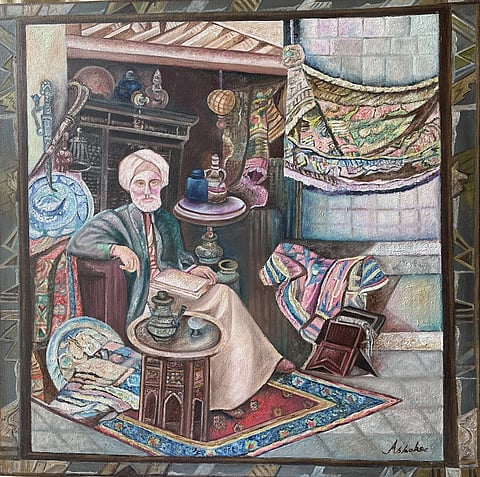

For Ashoka Sarkar, the city is not merely a backdrop — it is a living, breathing subject that continues to unfold across her canvases. In her works, she traces the quiet persistence of urban architecture, structures that hold unseen stories. A textile designer by training, Sarkar says that “design is in her blood.” Her inspiration comes from simply observing the spaces and structures around her, which she first captures in her sketchbook before they find their way onto the canvas.
On view in Delhi as part of the recently concluded exhibition ‘Art In Motion’, alongside artists Rekha Jaggi and Shashi Kumar Paul, Sarkar’s works explore the duality of city life. Her paintings capture the constant movement of a bustling metropolis, set against moments of stillness shaped by sunlight, shadow, and silence. Using abstraction, she transforms everyday elements into visual narratives. While her work often begins in realism, it rarely stays there. Abstraction enters organically, particularly through colour. “When I started playing with colours, abstraction automatically happened,” she explains.

For Sarkar, a painting is never a photographic reproduction. While the dimensions and core subject may remain intact, colour becomes the space where freedom resides. Buildings are not painted as they appear in reality; instead, they are reimagined through layered, unexpected palettes.
With panels built through layers of texture and colour, her palette plays a central role in shaping the mood of her work. Earlier phases of her practice leaned towards earthy tones — browns, beiges, and muted yellows. Today, her paintings move towards cooler, more contemporary hues. “Now I play a lot with bluish greys,” she says, “along with browns and touches of vermilion red, different shades of red, and mauve — colours that feel very contemporary.”
Her work moves between memory and documentation, and travel has been a turning point in her artistic life. Her journey has expanded across continents — from Mumbai to Dubai, Rome, Turkey, the Netherlands, Malaysia, and Germany. Each city left its imprint not only through architecture, but also through its cultural atmosphere and public response. Each canvas becomes a record of movement, belonging, and lived experience. Reflecting on her journey, she says, “I never felt I was in a foreign country. Wherever I went, I didn’t feel lost, even when travelling alone. Every place became significant in its own way.”