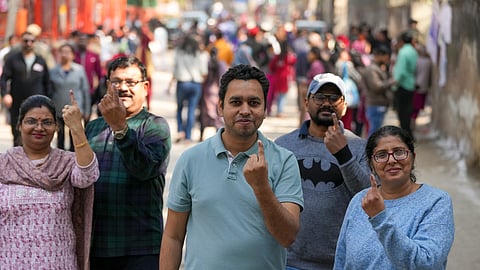

NEW DELHI: The middle-class vote, just like in previous elections, appears to be influenced more by the status of civic amenities and economic concerns rather than caste considerations.
While the AAP continues to enjoy support from direct beneficiaries of its welfare schemes, a section of the upper middle class is growing disenchanted.
South Delhi, which has a sizeable number of affluent and middle-class families, expressed dissatisfaction over civic issues. In Munirka, residents complain that AAP has failed to deliver on municipal matters after gaining control of the municipal corporation.
“Our locality is having contaminated water. Air is toxic, water is bad, potholes on roads everywhere,” said Vivek Dahiya, a 35-year-old ad sales professional from RK Puram, explaining why he voted for a change.
Meanwhile, economic concerns weigh heavily on many middle-class voters. GM Bhattacharya, a 73-year-old retired government official from Greater Kailash, argued that welfare measures should extend beyond lower-income groups.
“Freebies should be extended to income taxpayers as well since the middle class is suffering from back-breaking inflation. Increasing the tax limits to manage inflation will only work if the government can provide enough jobs. The youth is suffering from joblessness. Freebies are instant relief measures which should be extended to the middle-income group as well,” he said.
As the elections unfold, the shifting sentiments of the middle class could play a crucial role in determining the outcome, highlighting a growing divide between support for welfare-driven governance and demands for better infrastructure and economic relief.
