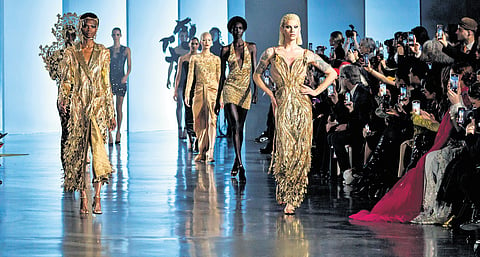

When we dialled couturier Rahul Mishra after his Paris Haute Couture Week show, the conversation opened with astonishment — ‘this collection is so different from what you’ve presented in the past,’ we told him. His label’s signature — the multi-coloured three-dimensional appliqué work that almost breathes life into his birds, butterflies, florals, dragonflies, bees and other wonders of nature — was missing. Instead of bright blooms, the designer crafted black scavengers like ravens and crows that sat on sheer-black bodysuits. In another one, he showcased a model wearing a three-dimensional glitzy cityscape, almost sending warning signs to humanity of raising skyscrapers at the cost of the environment.
Yet another dress dazzles with silver round mirrors. Take a closer look and it’s embellished with a cautionary message: ‘objects in the mirror are closer than they appear’. Each ensemble compelled one to pause and reflect on the future we are creating. “The edit is about philosophy, death, hope, recuperation, and survival but how do you create it? You can easily put it in words and maybe paint it, but how to put it in a show? We started from zero as there was no reference point. The collection resonates with people on a contemplative rather than a brighter note,” says Mishra.

Age of dystopia
Unlike many of his past collections like ‘Aura’, ‘Cosmos’, and ‘Tree Of Life’ showcased in Paris, this time Mishra did not look for any fantasy-like surrealist inspirations. He was moved by a personal tragedy that acted as a “catalyst” to unveil the darker truths of life through this collection.
“This year has been extremely challenging for me as I lost my father two months back. He was struggling with severe lung issues due to the toxic air in Delhi — a city where we see no sunlight for 10 straight days due to pollution. I was also worried about my nine-year-old daughter who needs to be rushed to our mountain home for clean air as air quality
worsens in Delhi every year. It leaves me wondering what kind of planet we will leave behind for our future generations as our way of life becomes increasingly unsustainable,” he says, adding that in ‘Pale Blue Dot’ he visualised a planet, which may become “inhabitable by humans” if our actions go unchecked.
Mishra expressed personal grief by using the crow as a symbol of dystopia yet hope. Speaking about their dual role, he said: “Crows are often disliked as birds as they feed on the dead, sitting on piles of waste. But, they also clean up the waste mounted by humans.
After I lost my father, we had to do certain rituals where we had to feed the crows as they are seen as a connection between the human and the spiritual world. In the collection’s pieces, I have reflected what I was going through within.”
Further, the usage of dominant shades of metallic grey, and black colours portrayed the ultimate truth of life — death. “The collection stems from a place of fear yet hope, loss yet slow healing and how all of this happens to me as a constant force,” he says.
Slow healing
While the pain of losing loved ones was difficult, Mishra still found hope. Gita’s verses and a spoken essay which later transformed into the book Pale Blue Dot (1994, Random House Inc) written by American astronomer Carl Edward Sagan helped him process loss. The book was inspired by a famous photograph of the earth taken by NASA’s Voyager 1 in 1990 — the first spacecraft that crossed the heliosphere.
“Switching between them, I felt that the significance of our lives and our fragile planet is determined only by our own wisdom and courage. Maybe in future, mankind will embrace a humbler existence, and nature will begin to reclaim the concrete jungles we have built,” he says adding,
“A couple of years back, I also watched this beautiful Netflix documentary Chernobyl 1986 where a city that went through a nuclear disaster was abandoned but was rejuvenated with life again. It’s true that when things fall apart due to imbalance, Mother Nature takes over as the ultimate force of renewal.”
Mishra used the gold-coloured satin, sequin and three-dimensional gold embroidery to capture the regenerative side of nature. Further, The Tree of Life — a common motif in many of his collections showing harmony with nature — was resurrected in a sculptural dress. Another gold sequin dress featured an artwork portraying a glimpse through a glass window into a world where nature is quietly reclaiming urban spaces.
He also shared a striking prototype of a dress with us featuring nature creeping through the cracks and crevices of the seven wonders of the world. “It shows how these valuable monuments will look in the future — broken or decayed. Nature will then act as the biggest wonder reminding us to take mindful actions,” Mishra says.
For the 45-year-old designer, this collection was not coming from a bright place but of profound realisations. “When you are going through some darker or negative emotions, the outcome is not flowery. I also consciously stayed away from our signature strength of bright floral motifs and multi-coloured embroidery as formulaic ways can bring your growth to a standstill. I wish to be versatile.
It’s the joy of creating something new that keeps the artist alive,” he says on taking risks with ‘Pale Blue Dot’. Moving ahead, the designer wants to be “more of himself” and not be “pressured by the trends” with each showcase. “I am gradually learning that even if a piece does not make news, it may just be part of the fashion history being created.”