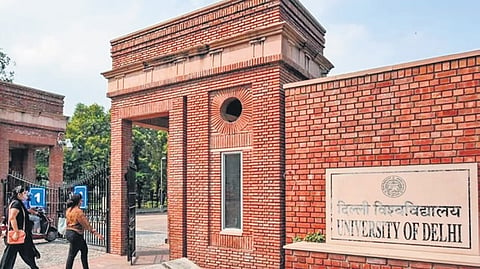

When the University of Delhi (DU) rolled out its ambitious four-year undergraduate programme in keeping with the National Education Policy (NEP) 2020, it promised flexibility, interdisciplinary learning, and research-oriented education. Instead, what unfolded on campuses has been described as a patchwork of confusion, infrastructural gaps, and academic chaos.
With fourth-year undergraduate (UG) classes set to begin this month, the University has quietly offered students the ‘exit option’ after three years — a tacit admission that DU is not ready to sustain the programme it had so confidently championed.
According to certain DU academic council members, the four-year UG programme has only led to deepening of infrastructural cracks across the colleges. Several of these institutions entered the academic year without approved syllabi for the new courses. Until last month, only 60% of DU colleges had approved the syllabus for the fourth year.
Compounding the problem is acute shortage of faculty — a concern flagged repeatedly by teachers — and the absence of dedicated infrastructure to support research or fourth-year-level coursework. Students have been exceedingly critical of the varsity move, citing unstructured classes, lack of clarity over minor courses, and a sense of being trapped in a ‘half-baked experiment’.
“What was meant to be a bold leap into the future of higher education now risks becoming a cautionary tale of reform without readiness. The implementation of DU’s four-year UG programme under the NEP 2020 has not only been criticised by the faculty, but almost every student for a simple reason that the system is riddled with administrative lapses, unplanned policy shifts, and a shortage of resources,” Chanchal Verma, a final-year economics student, sums up.
Academic Council objects
In a detailed note of action, submitted to the Vice Chancellor (V-C) during the academic council meeting held on July 5, Dr Maya John, an elected member of the panel, flagged several key issues, she said, are compromising the quality and feasibility of the programme.
Monami Sinha, member of DU standing committee and the academic council succinctly listed the impediments to the programme’s feasibility: “A 25% increase in student intake due to the EWS expansion in 2019, an additional 20% surge in admissions following CUET from 2022 to 2024, the fourth year potentially requiring colleges and teachers to accommodate a higher workload, besides the lack of infrastructure such as laboratories, reading rooms, and teacher workspaces severely undermines the programme’s feasibility.”
Citing lack of necessary funding, Sinha pointed out, “The proposal for en-masse undergraduate research in the fourth year demands substantial investment in advanced facilities, which remain unavailable... this rushed implementation without structural and financial support risks diluting the quality of education and pushing the system towards collapse.”
One of the most pressing concerns revolves around the late notification of mandatory Generic Electives (GEs). A University circular dated February 27, 2025 listed a series of compulsory GEs up to the sixth semester. However, this list was shared with colleges only after many students had entered their fourth year.
The timing of the notification has left many students of the 2026-batch in a bind. Several have completed only one or two of the newly-mandated GEs, and even those who have taken multiple electives may not have completed them in the prescribed semester order.
“This last-minute imposition of mandatory GEs violates the spirit of the UGCF (Undergraduate Curriculum Framework) 2022, which encouraged interdisciplinary choices rather than rigid structures,” Dr John pointed out. “Colleges are now struggling to offer both GEs and DSEs (Discipline-Specific Electives) across semesters owing to lack of required faculty to teach them.”
Dr John also highlighted in the meeting that this administrative misstep has further strained an already burdened teaching staff. With the introduction of a fourth year and new credit requirements, teachers are facing increased workloads without a corresponding rise in sanctioned teaching posts. In response to the faculty shortage, many colleges had allowed DSEs to double as GEs for students from other departments, but the rigid enforcement of semester-wise mandatory GEs has rendered this ‘work around’ unviable.
Adding to the confusion is the ambiguous structure of the BCom programme. While the UGCF flowchart mentions that BCom students will study core courses in Commerce along with “Allied Disciplines” like Economics and Management, the actual curriculum reflects only Commerce subjects as Discipline-Specific Cores (DSCs). As a result, students are unsure how they can qualify for a minor degree — especially since four out of their ten potential GEs are reserved for language courses.
“Many BCom programme students are left wondering if they will be eligible for a Minor degree at all,” the dissent note submitted to the V-C stated. “A formal clarification from the University is urgently needed.”
Another significant flaw flagged by the academic council members is supervision of UG research. Under the four-year structure, students undertaking a research project or dissertation in the final year are meant to receive faculty supervision worth six credits per semester. However, these supervision hours have not been included in a teacher’s official workload.
Dr John warned that this move would lead to unaccounted labour and eventually affect the quality of student research: “What is being proposed is essentially a shadow workload. Without accounting for these hours in the weekly timetable, the programme risks becoming exploitative and unsustainable.”
“Perhaps the most alarming of all is the University’s restriction on appointing guest faculty. Recent DU and UGC notifications have limited guest appointments to leave vacancies alone and capped them at 20% of sanctioned teaching posts. This has crippled many colleges’ ability to manage the extra teaching burden generated by the fourth year, as well as common courses like Value-Added Courses (VACs), Skill Enhancement Courses (SECs), and Ability Enhancement Courses (AECs),” Dr John said.
“The University claims to support colleges in implementing the four-year structure, but its own circulars have made that virtually impossible,” Dr John asserted. “With rising workload and no parallel increase in permanent posts or guest faculty, the whole structure is imploding.”
In closing, Dr John cautioned that without a serious overhaul, the four-year UG programme would become a “mockery of college education.”
“The goals of NEP 2020 are being undermined by poor planning and resource gaps. What we’re witnessing is a top-down implementation with no ground-level support,” she said.
Rudrashish Chakraborty, a faculty in the English department of Kirori Mal College contended, “There is no infrastructure in colleges to conduct quality research at the UG level in terms of space, infrastructure, laboratories, etc. The component of research supervision is not being acknowledged as workload on the teachers. This puts an excessive burden on faculty members who are already inundated with work.”
Chakraborty further pointed out that hardly any funds had been allotted for research work in the fourth year of the UGCF, making quality research nearly unfeasible: “Colleges are left to fend for themselves and are being advised to mobilise funds through the Students’ Fund instead of funding from the Government. Students are forced to study four taught courses besides having to write a dissertation. This takes the focus away from quality research and leads to half-baked and poor research outcomes which become mechanical in nature instead of being an original contribution to human knowledge.”
Echoing the similar opinion, academic council member Anumeha Mishra said one of the guidelines for research supervision expects students to publish in a scopus-indexed journal as an outcome of their research. “This is patently unrealistic as such publications are not possible within the stipulated one-year period during the fourth year and even teachers find it extremely difficult to have such publications. This provision will act as a disincentive for students to pursue the fourth year,” she asserted.
Mishra further said the varsity must refrain from applying a ‘one-fit-all-size’ model in approving projects eligible for research funding under the Institution of Eminence and a discipline-specific parameter must be evolved.
DU Registrar Vikas Gupta disposed of all the concerns raised by academic council members, saying a certain group among the faculty are opposed to the NEP’s vision. “The criticism of the FYUP (four-year undergraduate programme) is from specific six-seven members who are against the NEP 2020. Students who would take admission in postgraduate programmes elsewhere must drop out after third year. By July 31, we’ll know how many students made an exit from the fourth-year programme.”
Exit strategies
With the academic deadline to roll out the FYUP approaching, the DU last week issued an official notification informing students in the programme that they can opt to exit after completing six semesters (three years), amid mounting concerns over the institution’s preparedness to provide the necessary infrastructure.
With several DU colleges operating without up-to-date laboratories, a finalised curriculum, and adequate infrastructure to support the extended programme, the University in their notification stated, “Candidates who plan to submit their intent will get a three-year degree for multi-core discipline programmes or an Honours degree for single-core discipline programmes, as applicable.”
The varsity also mentioned that it encourages eligible students to carefully evaluate their academic and career goals before making a decision and recommends consulting with teachers and mentors to ensure informed decision-making. “This initiative aligns with the NEP 2020, which emphasises providing multiple entry and exit points in higher education, thereby offering students enhanced autonomy over their educational pathways,” read the notification.
Speaking to the newspaper, general secretary of the Democratic Teachers Front Abha Dev Habib had earlier said the university has created a situation where most students drop out before entering fourth year. “Even if they join the fourth year, it will not make sense considering the fact that the core syllabus has been slashed badly,” she said.
In her sharp criticism of the authorities, the Habib said, “The university is trying to pull down the quality of the education by overloading an already vulnerable system. Creating the infrastructure in minimum time is not possible. It’s not something which you can build overnight. A lot of time is required. Permissions are needed, money is needed. However there are no talks about money. They are talking about the research component and they want the outcomes to be steep, how will that be possible?” she had questioned.
As the University continues to navigate the rollout of its flagship undergraduate programme, the coming months will reveal whether these concerns are taken seriously — or left buried under administrative silence.
“DU’s implementation of the FYUP has been chaotic. The syllabus was released late, infrastructure hasn’t been upgraded, and there’s already a faculty shortage—so who will teach the fourth year? Where will they sit?” DU student Savvy says, questioning the move.
What is FYUP?
Under the Four-Year Undergraduate Programme (FYUP) implemented by DU in keeping with the NEP-2020, students have the option of pursuing a research-oriented degree with a dissertation, an academic project, or an entrepreneurship track. The programme, introduced in 2022 under the NEP offers multiple exit points to students: a certificate after first year, a diploma after second year, and a degree after third year. Those completing the fourth-year course have the option for a one-year master's programme.What is FYUP?
Under the Four-Year Undergraduate Programme (FYUP) implemented by DU in keeping with the NEP-2020, students have the option of pursuing a research-oriented degree with a dissertation, an academic project, or an entrepreneurship track. The programme, introduced in 2022 under the NEP offers multiple exit points to students: a certificate after first year, a diploma after second year, and a degree after third year. Those completing the fourth-year course have the option for a one-year master's programme.
Dissent note from faculty members seeks interventions
Exemption for the batch of 2026 from completing the three newly-mandated GE papers
Clarification on the BCom programme structure and the route available for obtaining a Minor degree
Inclusion of undergraduate research supervision within a teacher’s weekly workload
Immediate increase in funds and sanctioned faculty posts to ensure the 4-year UG programme is academically feasible
