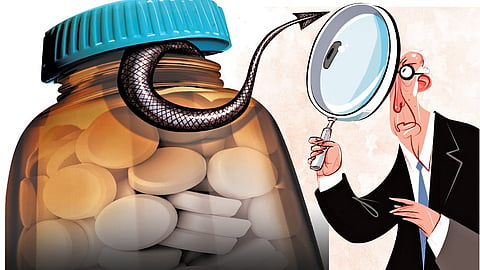

Delhi has long stood as a beacon of modern healthcare. The national capital is home to gleaming hospitals, internationally trained specialists and cutting-edge treatments. Its medical tourism industry draws patients from every corner of India and beyond.
Cancer care in the city is considered among the best in the country, renowned for its precise surgical procedures, immunotherapy, targeted drugs, multidisciplinary tumor boards and clinical trials. For many, the city offers hope where once only despair ruled. But behind the shiny facades of these world-class medical institutions lies a dangerous and dark underbelly: a sprawling counterfeit drug network that has infiltrated the very supply chains that patients trust with their lives.
These are not mere cheap knock-offs; these are criminal deceptions that put patients at grave risk, especially those battling life-threatening illnesses like cancer..
The Crackdown
In June, the Delhi drugs control department executed a citywide operation that uncovered the depth of the problem. Over 160 samples of suspected cancer medications were seized—many lacked proper documentation or bore suspicious markings. This comes as a suo motu action after Delhi Police busted a well-organized racket allegedly responsible for selling fake and unauthorised cancer drugs to patients.
Within days, six individuals were arrested. The raids took place in Laxmi Nagar, Budh Vihar, and Chandni Chowk—areas selected for their proximity to major medical institutions such as AIIMS, Safdarjung, Lok Nayak, and Rajiv Gandhi hospitals.
The haul recovered from one raid included vials worth `2.15 crore, 519 empty vials labelled as Keytruda, Infinzi, Tecentriq, Perjeta, Opdyta, Darzalex; 864 empty packaging cartons; along with packets of counterfeit solutions.
Teams scoured prominent medicine markets in Daryaganj, Bhagirath Palace, and Laxmi Nagar, inspecting drugstores, crosschecking stock registers, and reviewing bills. Fifteen firms emerged with inconsistencies and the department filed charges under the Drugs Rules of 1945.
“Sale and purchase records of these 15 firms revealed billing discrepancies. Some firms could not provide any records. The department has initiated action under the Drugs Rules, 1945,” an official from the drugs control department said.
Dark web of fake drugs
At the heart of the racket remains Bhagirath Palace—a sprawling wholesale medicine market, notorious for being a transit point for counterfeit drugs. According to officials, illicit consignments are shipped from here to other states, such as Agra, Patna, and Jharkhand, bypassing Delhi’s regulatory oversight.
Authorities uncovered an alarming modus operandi. Hospital staff secretly removed empty vials of premium oncology medications meant for disposal. These vials were sold to brokers who then refilled them with unknown or low cost solutions.
The operation was so organised that refilling labs had professional sealing machines, packaging materials, and replica labels.
The refurbished vials, bearing legitimate labels, reentered the supply chain via medical stores and online portals, packaged as genuine immunotherapy drugs like Keytruda, Opdyta, Darzalex and others containing no active ingredients.
Investigations revealed that empty vials of immunotherapy drugs like Keytruda, Opdyta, Tecentriq, Perjeta, Darzalex were harvested from treatment rooms and used again. The refilled vials were indistinguishable to patients and pharmacists, accelerating the blurring of legal and criminal lines.
“Empty vials of genuine medicines are sold to unscrupulous dealers, who refill them with fake substances. These are then pushed back into the supply chain and sold to unsuspecting patients through pharmacies and online platforms,” said an official privy to the probe.
“Many of the accused work in a hospital. Their duty was to dispose of empty vials after the cancer medicine was used, but they sold these to associates who then refilled these and supplied them for sale,” the official added.
Investigators found mobile phones and messaging app accounts linking accused suppliers to patients. WhatsApp groups and Telegram channels served as discreet marketplaces—avoiding storefronts, bypassing records. Digital payments and courier shipments replaced receipts. A senior officer stated that Delhi Police monitor such chatter continuously, acting on tip offs to dismantle nodes of operation. “But in a sprawling city with tens of thousands of pharmacies—and thousands more online drug outlets—comprehensive policing remains an immense challenge,” the official further added.
Drugs under microscope
Among the 160 plus samples seized, several critical cancer medications were found. One such drug is Imatinib, available in both 400 mg (marketed as Veenat 400) and 100 mg variants. Imatinib is commonly used alone or in combination with other therapies to treat various types of cancer, particularly chronic myeloid leukemia (CML) and gastrointestinal stromal tumors. It works by targeting specific enzymes that help cancer cells grow, effectively halting their progression.
Also recovered was Capegard 500, a chemotherapy drug used primarily in the treatment of breast, colon, and rectal cancers. Armotraz, another drug found during the raids, is prescribed for hormone-receptor-positive breast cancer in postmenopausal women. Authorities also seized Hydroxyurea Capsules IP 500 mg (Leukocel 500), essential for treating CML by interfering with the growth of abnormal white blood cells. Additionally, Cycloxan tablets, used to manage a range of cancers and nephrotic syndrome—a serious kidney condition—were discovered among the counterfeit stocks. The presence of these medications underscores the severity of the counterfeit drug racket, as many of these treatments are life-sustaining for patients in critical stages of illness.
Additionally, high-end monoclonal antibodies and immunotherapy drugs—including Opdivo, Perjeta, Keytruda, Erbitux—involved in relapsed or metastatic cancers were part of the illicit trade. All seized items were sent for lab testing in Delhi and Chandigarh, and results are expected within three to four weeks.
Economics behind the scam
The counterfeit syndicate preyed on patients’ financial desperation.
Genuine doses of branded biologics retail between `1.5 lakh and `2 lakh. By offering the same drugs at way below the market price, the network lured desperate patients and low income hospitals. These cheap refills—possibly saline mixed with inert agents—were sold for prices ranging from `50,000 to `70,000 lakh per vial, depending on the brand.
Buyers paid less than market rates for what looked like expensive biologics—but in fact received nothing therapeutic. The razor thin cost of refilling vials combined with the high retail price meant extremely lucrative illegal profit margins.
Authorities take action
The Delhi drugs control department has organised ten teams—each led by a drug inspector. Phase I of the inspection, conducted in June, covered wholesale distributors and smaller retail outlets. Phase II is expected to begin soon and will target high-volume drug stores that specialise in anti-cancer medications, according to officials.
“We have cross verified stocks, invoice ledgers, supplier details, and delivery receipts. We will also seek help from pharmaceutical manufacturers to authenticate seized samples,” an official said.
Meanwhile, confirmatory reports of the samples are expected soon which will help identify whether confiscated batches are authentic or spurious. Based on that, further actions, including criminal prosecution will follow, the official added.
While cancer drugs carried the highest risk, drug inspectors also uncovered falsified medicines meant for chronic disease blood pressure and cholesterol control.
This counterfeit consignment, recently seized in Okhla and Chandni Chowk, was linked to suppliers in Dehradun. Delhi health authorities have also coordinated with their counterparts in Dehradun.
A deep-rooted problem
This latest crackdown represents the second major exposure of spurious cancer drugs in the last 18 months. In March 2024, Crime Branch of Delhi Police had busted a racket of manufacturing and supplying spurious chemotherapy drugs and arrested seven people.
Police had conducted simultaneous raids at two flats in Moti Nagar, one in Gurugram, one in Yamuna Vihar, and a cancer hospital in Delhi. Two flats in DLF Capital Greens, Moti Nagar, was the main location where the spurious cancer medicines were being manufactured by Viphil Jain, the kingpin of the racket.
He had taken 2 EWS flats at DLF Greens, Moti Nagar and was using the same to refill the spurious cancer medicine (vials), officials said.
During raids, 140 filled vials of spurious cancer injections of Opdyta, Keytruda, Dextrose, Fluconazole brands were seized along with three cap sealing machines, one Heat Gun Machine and 197 empty vials and other essential packaging material. At the Gurugram flat, one Neeraj Chauhan hoarded a large cache of counterfeit cancer injections. At the instance of Neeraj, his cousin Tushar Chauhan was also nabbed. From Yamuna Vihar, the police nabbed one Parvez, who arranged empty vials for Viphil Jain and was also involved in supply of the refilled vials.
A senior Delhi Police officer said that they continuously monitor such kinds of activities across the city as well as outside the national capital.
“We have several special units which work dedicated to the field of drugs. We keep a watch whether any such practice is being done in order to get easy money. We raid such areas after getting a tip-off and take appropriate action against the offenders. We have arrested several people indulged in a fake drug racket. The Delhi Police reaffirms its commitment to safeguarding public health and protecting vulnerable patients from such dangerous criminal networks. This is an ongoing exercise,” the officer said.
Next steps for authorities
The immediate focus is on finalising drug test results and issuing public advisories. Delhi’s Health Minister Pankaj Singh has urged the public to only purchase cancer medications from authorised pharmacies and to report suspicious dealers. The Delhi drugs control department continues sampling and inspection, collaborating with original manufacturers and labs. Legal proceedings will intensify as test results identify which businesses were responsible for distributing counterfeit drugs.
Prosecutions under the Drugs Rules, PMLA, and other statutes are already underway. Authorities are also reviewing hospital waste protocols, proposing reforms to prevent future misuse of empty vials.
“We are waiting for the report. If any medicine is found to be duplicative or of poor quality, strict legal action will be taken against the people and companies concerned,” Singh said.
Delhi Congress chief Devender Yadav said the consumption of fake medicines alongside genuine ones is thriving due to weak monitoring systems, corruption, and the complicity of government machinery.
“The counterfeit drug trade in the capital has become an organised industry, operating through a well-planned network and transportation system with the collusion of corrupt officials. This trade also involves unlicensed factories that produce fake medicines with identical packaging, barcodes, holograms, and QR codes, mixing them with genuine medicines for supply to cheat the gullible patients,” he said.
“The supply of fake medicines to hospitals not only endangers public health but also puts the nation’s reputation at risk,” he added.
How patients can stay safe
Even as investigations roll on, patients are advised to exercise caution. Ensure the drug packaging has visible batch numbers, expiry dates, seals and a trusted logo.
Labels stating “Not for Sale in India” on drugs presented for domestic sale must be red flagged. Only purchase from CDSCO licensed pharmacies or hospital dispensaries, and always ask for a bill. Be wary if a branded biologic is being offered at a dramatically reduced price. Report suspicious packaging, labeling, or pricing—photograph anomalies, make note of the vendor, and immediately inform the Health Department or Police.
The racket exposes structural weakness in the country’s pharmaceutical ecosystem.
Hospitals need stringent disposal tracking, especially for premium-level drugs. Supply chains from manufacturers to patients must become fully traceable—ideally through digital tagging. Online platforms must be regulated to prevent illicit drug listings. Distribution across states must be carefully coordinated. With the growing threat, the crackdown against this network is just the beginning of a much-needed overhaul to safeguard public health.
