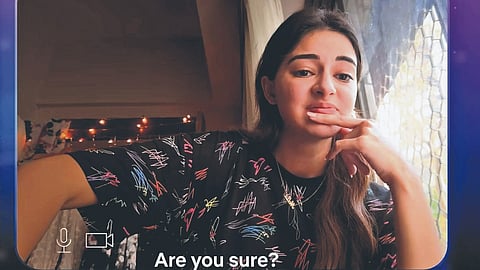

According to a Mary Meeker’s AI Trends report of May, India makes up 13.5 per cent of global ChatGPT users. For many, ChatGPT has become a modern-day Swiss Army knife that writes college assignments, suggests budget skincare, helps plan balanced meals like a dietitian, and finds the perfect Mother’s Day gift without having to trudge through link-baited websites. Across Delhi-NCR, young people are, however, turning to ChatGPT not just for everyday chores, but for emotional anchoring—processing emotions they don’t feel safe sharing elsewhere.
Rachel Gupta, 23, a Delhi University graduate, began using ChatGPT for venting out to grieve the loss of a parent and after going through a breakup—after her university counsellor suggested it. “It sounded weird at first,” she says. But soon, it became the place to say the unsayable. Gupta's not alone. For 21-year-old student Gia Srivastava*, the appeal lies in how predictable and undemanding the interaction is. “Sometimes, you just want someone to listen without interruptions, without consequences.”

Saman Fatima Nomani, a marketing communications professional, turned to ChatGPT because it offers a rare space, free of judgment or punishment. "You can say what’s on your mind without being punished for it,” she says. Being a neurodivergent person working remotely, for her, ChatGPT became a sounding board in unfamiliar territory; for the neurodivergent, it’s hard to accurately read subtext or social cues. “This can be especially tricky when you’re working with people from different cultures and backgrounds,” says Nomani. “It wasn’t about overthinking—but about needing help navigating situations that didn’t come intuitively to me.”
ChatGPT is especially popular with Gen Z, and there’s a reason why. A generation that seems over cautious about image and authenticity, needs to be, or at least appear, on the right side of things. Riya Jain, 21, a PR professional, for instance says, even if she is talking to a friend, she is careful “about every word I use. I overthink how it’ll come across”. Brand consultant Pooja Saha echoes the sentiment saying sometimes certain thoughts feel too raw, unclear, or ‘too much’ to share with someone. “With ChatGPT, there’s no need to worry about rumours, reactions, or awkward follow-ups,” she says.
ChatGPT: it’s always there
ChatGPT also works for many simply because it’s always there. For Srivastava, it wasn’t her first choice—but it ended up being the one that worked. “I was in this weird state. I tried calling my closest friend in Bombay, but she couldn’t pick up.” She remembered all the memes about people using ChatGPT like a therapist and figured, why not. “When I typed everything out, it didn’t rush to fix me or offer advice. It just held space—that was enough.”
Sometimes, the fear of being a burden makes us hold back from reaching out to others. For Chiaa Pandey*, 22, a PR professional, moving to Gurugram to live alone and juggling long work hours meant often having no one to talk to. “I started using ChatGPT like a person I could talk to, because you can’t always tell your family everything about your daily life,” she says.
Therapy or not-quite?
The idea of therapy, too, can feel intimidating, expensive, or out of reach. You may also not connect with the first therapist you meet. “With ChatGPT, it’s just you and a keyboard. People—especially our generation—are more comfortable typing things out. It feels anonymous, private, like the conversation won’t leave the screen. Vulnerability in front of others is still seen as weakness sometimes,” says marketing strategist Raj Oberoi. Saha agrees. For her, affordability was a barrier early on. “In those moments, AI became a quick, easy, and accessible emotional support system,” she says.
“I eventually managed to attend a few therapy sessions once my financial situation improved,” she adds. “Even if therapy were free and easily accessible, I’d still turn to ChatGPT now and then. There’s something comforting about not having to sit across from someone, not having to justify every emotion or explain everything in detail.”
Chatbot versus therapists
Psychologist Chaitanya Jonker, who works closely with young clients, says she’s noticed a rise in people using ChatGPT to vent or seek comfort. She cautions against seeing AI as a substitute for real therapy. “This is a debate going on. AI cannot replace therapy. The human touch is very important,” she explains.
In her experience, AI can reinforce isolation by offering surface-level validation. “ChatGPT is a reflection of how you are…it’s not unbiased. It catches on to your emotions.” She recalls a client nearly returning to an abusive partner based on the AI’s seemingly neutral suggestions. “GPT isn't human. It keeps giving you validation—but not the growth or accountability a therapist offers.”
Another client, guided by ChatGPT’s advice to “do something nice for yourself,” began ordering coffee daily. It comforted her emotionally, but eventually led to a pre-diabetic stage. “It helped her ground herself in the moment—but it also elevated existing health issues,” Jonker says. “Sometimes people don’t realise how dependent they’re becoming.”
In a world where loneliness, and mental health struggles are surging—ChatGPT is filling a gap, not as a therapist, but as a safe space. But this also raises deeper questions: What happens when a generation becomes more comfortable opening up to a machine than to other humans? What does it say about our friendships, our families, or even the way we engage with vulnerability itself? As we lean more on AI for emotional processing, the real challenge may not be whether it can replace therapy—but whether we’ll still know how to show up for each other.
(* Names changed on request)