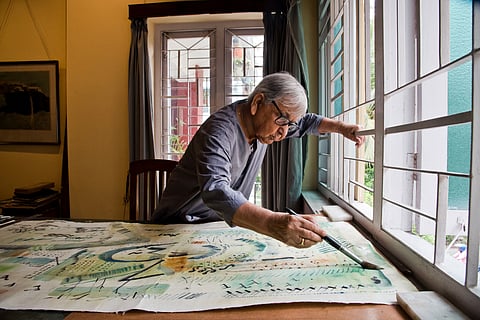

At Akar Prakar Gallery in Delhi, paintings of stylised Ajanta’s ancient frescoes—narratives of events from the lives of the Buddha, the Jatakas—adorn the walls. These paintings are reproductions of Ajanta cave murals by veteran artist Ganesh Haloi, who was assigned by the Archaeological Survey of India (ASI) in 1957 to replicate the frescoes. Over the next seven years (1957–1963), he recreated them, capturing their essence and preserving their pictorial structure.
Among the works exhibited in the exhibition ‘Figure-ing Out: The Ajanta Project and Now’, is the tale of a golden goose king caught in a snare, nursed back to health by a repentant hunter from Mahahamsa Jataka. Other works depict murals based on the Vessantara Jataka and Mahajanaka Jataka. These paintings remained in Haloi’s personal collection for over 60 years. “They haven’t seen the light of day until this exhibition,” says Siddhi Shailendra, the curator of the gallery.

Ajanta murals
During his time at Ajanta, Haloi polished his traditional painting techniques while creating mural reproductions. He also crafted numerous ink sketches, forming a deep connection with the local community. Rendered in ink and brush on paper, these sketches vividly depict their everyday lives.
Haloi’s art has always been multilayered, much like the ancient murals he studied in Ajanta. “Most of these paintings are not single-layered compositions. He paints over and over again, layering watercolours to achieve depth,” notes Shailendra. This technique allowed him to capture the original vibrancy of the cave murals, many of which have deteriorated over time. His work was not just about replication—it was about preservation, ensuring that future generations could appreciate the imagery that had already begun fading.
In the early years, Haloi remained faithful to Ajanta’s colour palette, using earthy tones, blues, and greens. However, as his practice evolved, he gradually broke free from traditional colour constraints. Though he experimented with oil painting in the 1970s and 1980s, he ultimately returned to water-based pigments, favouring watercolour and gouache.
Later abstractions
His teaching career further influenced this transition. While instructing students in the basics of form—lines, circles, crosses, dots, and dashes—Haloi began incorporating these elemental structures into his own work. Today, his paintings are often interpreted as aerial landscapes, though he describes them differently: “For me, it’s not just an aerial view. It’s my view, where I am immersed in the landscape.”
The exhibition traces Haloi’s artistic transformation. “When you look at his Ajanta paintings, they are highly figurative. But over the years, you see him moving away from figures entirely,” says Shailendra. Haloi’s shift to abstraction wasn’t abrupt; rather, it was a natural evolution of his artistic inquiry.
By showcasing Haloi’s Ajanta period works alongside his recent creations, the exhibition not only highlights his artistic evolution but also honours his role in preserving historical art, Shailendra says. While his early pieces remain deeply rooted in Ajanta’s themes and style, his later works diverge significantly, embracing abstraction.
Haloi’s journey—from preserving Ajanta’s murals to forging his own path in abstraction—is a demonstration of the lasting dialogue between tradition and innovation in Indian art. Even at 89, Haloi continues to explore reminding us that art is a lifelong journey of continuous reinvention.