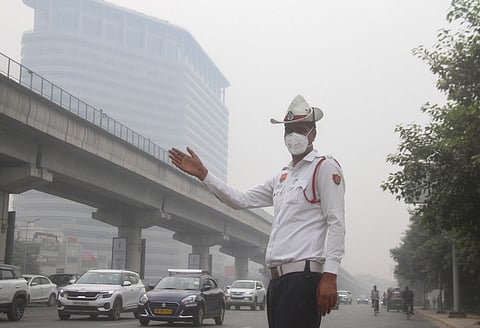

The Constitution of India guarantees every citizen the right to life under Article 21, a phrase our courts have rightly expanded to mean not mere existence, but a life lived with dignity, health, and ecological balance. Clean air, therefore, is not a privilege, but a constitutional entitlement.
Yet, each winter, Delhi seems to enter what may be called a fifth season, the season of pollution, where the very air that sustains life becomes its greatest adversary. Ancient India regarded air as sacred: the Manusmriti declares, “Pawan shudhi sarvabhutanaam” (air is the purifier of all beings). Today, the purifier itself cries out for purification. This inversion of nature’s order is not merely an environmental failure; it is a civilisational breach, demanding that environmental law be asserted as the modern embodiment of the moral and natural order that sustains creation.
India’s classical poets saw rhythm in the succession of seasons, six in harmony, each completing the other. Kalidasa, in the Ritusamhara, sang of this balance: “At the meeting of winter and spring, the groves shine forth with blossoms.” But Delhi today knows a new rhythm, the Pollution Season, which descends between autumn and winter, not with blossoms but with smog. The Vedic declaration “The seasons unfolded with the very act of creation” once symbolised harmony between man and nature; today it stands shattered by human excess.
The city’s carrying capacity, its ability to absorb pollutants, has long been breached. Studies reveal how vehicular emissions, industrial discharge, construction dust, and crop residue burning combine each winter to choke the capital. Nestled within the Indo-Gangetic plain, hemmed in by the Himalayas and the Aravallis, Delhi becomes a bowl of stagnating air, a trap for its own breath.
This is not an atmospheric inconvenience, but a constitutional crisis. The High Court of Delhi once likened the capital to a “gas chamber”, capturing the desperation of a city where governance has failed to deliver on its most basic duty to protect life of its citizens. According to the IQAir 2024 World Air Quality Report, Delhi’s particulate matter levels are nearly 25 times higher than WHO limits, a grim measure of collective negligence. Citizens now prepare for this “fifth season” not with celebration, but with survival kits, air purifiers, N95 masks, sealed windows, and antioxidant diets, all in an attempt to endure what should have been a simple, natural transition of weather.
Environmental jurisprudence in India has evolved as a dialogue between constitutional conscience and ecological necessity. The triad of Articles 21, 48A, and 51A(g) forms the architecture of this dialogue, guaranteeing the right to a healthy environment, obligating the state to protect it, and imposing upon citizens the duty to safeguard nature. The Supreme Court has expanded the meaning of life under Article 21 to include clean air and sustainable ecology, holding that degradation of the environment strikes at the very root of fundamental rights. In Subhash Kumar vs State of Bihar and M C Mehta vs Union of India, the court declared that environmental protection is not merely a policy directive, but a right intrinsic to life itself.
To operationalise these principles, Parliament enacted a framework of legislation, the Air (Prevention and Control of Pollution) Act, 1981, the Environment (Protection) Act, 1986, and the Wetlands (Conservation and Management) Rules, 2010, among others. Yet, as Delhi’s skies testify, laws without institutional backbone are like lungs without breath. Nearly 49 per cent of sanctioned posts in the state pollution control boards remain vacant, leaving the enforcement machinery crippled.
In this vacuum, the judiciary has become the custodian of the nation’s ecological integrity. In M C Mehta vs Kamal Nath, the court reaffirmed the public trust doctrine, holding that resources like air, water, and forests are nature’s gifts held in trust by the state for the public. In M K Balakrishnan vs Union of India, it directed the protection of over 2,01,503 wetlands, emphasising that ecological preservation is not optional, but obligatory.
This principle of trusteeship now extends even to urban airsheds and man-made ecosystems. The court’s observation in Futala Lake (Nagpur), warning that construction would alter the nature and use of the waterbody, reinforces that the state’s role is that of a guardian. Upholding this trust is both a constitutional command and a moral duty.
As we stand in this “pollution season,” science, law, and morality must converge. Cloud seeding, though innovative, represents both promise and peril, a scientific attempt to cleanse the air, yet an experiment whose ecological costs remain uncertain. The path forward is to integrate such technologies within a framework of precaution, accountability, and transparency, ensuring that every innovation serves the public trust.
Gaurav Kumar Bansal
Climate lawyer and activist
(Views are personal)
