
In Ladakh’s Garkon village, an elderly woman named Tsewang Dolma was busy drying tomatoes on a sunlit terrace for winter storage before the season would knock on her doors. It was then that Manou came across the 70-year-old lady. The red tomatoes, glistening golden in sunlight, now are a part of Manou’s photo album.
The photo shows slices of tomatoes, turned golden-orange in colour, spread across a white sheet. In another picture Dolma can be seen looking sideways at the camera, directly—her expressions are sharp, with lips curved in a small grin. Dolma sits on a green tarpaulin, holding a knife in one hand and a tomato in another. Numerous other slices spread across the large green sheet—some uncut ones kept beside the old lady. Large mountains and tall, green trees peek in the background.
Similar photos by Manou, depicting the daily life of people living in the Himalayas, have been featured at the exhibition ‘Everyday Ordinary’, at Museo Camera Gallery in Gurugram, which will be on view till November 2.

Beauty in the ordinary
Manou was a familiar face in India’s fashion industry before he landed in the Himalayan highlands. A graduate of the National Institute of Fashion Technology, he started photographing while studying fashion communication. In 2010, Manou kicked-off his own blog ‘Wearabout’, which was primarily based on India’s street fashion. Soon after, his photographs found their way in various publications like The New Yorker, The Guardian, and The Hindu.
“I started by photographing people on the streets while I was volunteering in Dharamshala and then continued that on at fashion weeks,” the photographer recalls. “But gradually, I wanted to see more places and people in other parts, and have a broader experience outside of the big cities.”
This thought led Manou to many places—Rajasthan, Shillong, Nagaland, Ladakh, Tamil Nadu, and Mizoram.
The ‘Everyday Ordinary’ series is an exhibition scooped out of a larger project, The Great Himalayan Exploration. It is a long-term initiative by Royal Enfield and UNESCO to map and preserve cultural heritage of the place. This eventually led the photographer to the Himalayan highlands, where over the last two years, he has travelled through Nagaland, Mizoram, Sikkim, Tripura, Meghalaya, Assam, Ladakh, and Himachal Pradesh.
“When I returned to Ladakh after ten years, I could see the changes that we have been reading about, in the news,” Manou says, comparing his recent visit to prior ones in the land of high passes. “Locals spoke of receding glaciers, of river water turning undrinkable, of the tourist season stretching longer each year.”
Hence, climate change, Himachal weavers, terrace farmers are often the subjects of Manou’s works in this project.
The process is initiated, always, by talking. “I don't always take the camera out right away,” he says. “I talk to them, ask questions, and take what is offered. Some agree to be photographed, some don’t, and that’s okay. It’s so much about trust.”
On his experience of meeting different communities during his tour, Manou says it was enriching. For instance, the photographer was initially told that people in the Garkon village might be reserved, and reluctant to talk. However, the encounter with Dolma had a different story. “She [Dolma] welcomed me and treated me like family. She invited me to her house, offered me tea, showed the textiles she had woven, and the jars of dried fruits and vegetables she’d stored for winter." It was all ordinary and so beautiful,” the photographer tells TMS.
True to place and people
More works displayed at the exhibition include pictures of the tribal women, men wrestling, the weavers’ handlooms, young girls sitting together, among others.
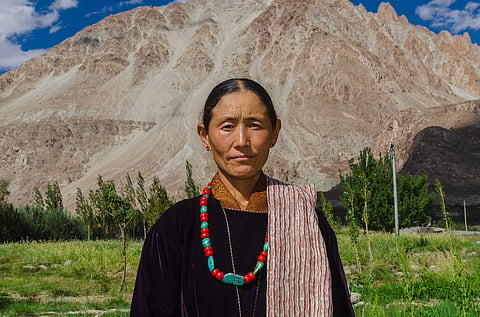
In one of the photos, a woman wearing a deep purple garment, looks directly at the camera. Over her left shoulder is a striped, beige shawl. Huge, arid mountains dominate the background, against a bright-blue cloudy sky.
“There are already many photos that show traditional practices followed by dwellers in the Himalayas," the photographer remarks. “I wanted to show how people live around those traditions.”
After having spent months travelling across the mountains, he understands the responsibility of portraying it truthfully. “I want to be creative and the photos to be unique,” he points out. But, he says, he also wants to keep it true to the place, to the people, and represent them the best way.