
In the realm of public relations and advertising, it is often said that the tools of mass communication have a limited capacity to add lasting value to a product or, in this case, a government, if the substance itself fails to deliver. A time-tested saying reminds us that good work speaks for itself.
Yet, there exists a contrarian school of thought which argues that this is a myth. Good work, it says, is indeed the foundation, but not sufficient on its own. For work to be recognised and rewarded, it must be made visible through subtle, strategic communication and by aligning it with what matters most to the audience. Visibility, in this sense, is not vanity, but validation.
However, between visibility and vanity lies a thin, often dangerous line, one that the Rekha Gupta-led Delhi government appears to be precariously treading. What began as a genuine attempt to communicate progress has, at times, veered into overstatement, giving its opponents, especially the Aam Aadmi Party, a fresh opportunity to re-enter the political narrative.
The government recently found itself in avoidable turf wars with the opposition on two fronts: first, over deteriorating air quality after firecracker violations during Diwali and, then, over the state of the Yamuna river in the run-up to Chhath festivities. In both instances, communication, not performance alone, became the flashpoint.
The Gupta government, to its credit, has been working diligently to restore effective governance in the capital. But, there are human, administrative and temporal limits. A city that had remained largely unattended in matters of governance for nearly a decade cannot be transformed overnight. It is unrealistic to expect that the Yamuna could be cleaned in just nine months. Nobody reasonably expected that either. The problem, therefore, lay not in the performance, but in the promise.
By declaring that the Yamuna would be clean within months, the government raised expectations to unsustainable heights. The result was predictable: unmet promises created space for criticism, allowing AAP to regain lost ground that could have been avoided with more measured communication.
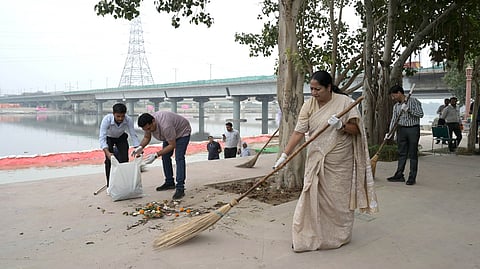
The irony is that the government did achieve visible success elsewhere. Tremendous efforts were made to rejuvenate ponds and water bodies across the 70 Assembly constituencies for Chhath celebrations, a work widely appreciated by local communities. Yet, all this good work was overshadowed by one ill-advised decision of building a temporary pond on the banks of the Yamuna to demonstrate its cleanliness.
That symbolic gesture backfired spectacularly. Instead of showcasing environmental improvement, it exposed the administration to ridicule. What could have been a quiet, dignified assertion of work turned into a spectacle of self-congratulation.
The lesson here is simple, but profound. In communication, timing and tone matter as much as content. Governance, like advertising, thrives on credibility, not hyperbole. When publicity exceeds performance, it not only erodes trust but also diminishes genuine achievements.
Piyush Pandey, the doyen of Indian advertising, once remarked that “If you look into the screen, you will see the data; if you look outside the screen, you will see the world”. This aphorism captures the crux of Delhi’s current dilemma. The government’s obsession with screens, press releases, social media posts, and promotional reels has distracted it from the world outside, the citizens who judge not by claims, but by lived experience. Gupta’s administration would do well to let people see its work not through filters and slogans but through tangible change in their neighbourhoods, streets, and services..
In a hyper-mediated environment, where every act of governance is instantly broadcast, leaders face immense pressure to perform and project simultaneously. Yet, as history repeatedly shows, governments that over-communicate without proportionate results lose their narrative faster than those that under-communicate but deliver steadily.
Gupta’s government has the advantage of sincerity and visible administrative effort. What it must now guard against is the temptation of over-promotion. Delhi does not need its leaders to tell citizens how clean the Yamuna is; it needs them to make it cleaner tomorrow than it was yesterday.
Ultimately, in both governance and advertising, credibility is built not by noise but by nuance. As Pandey’s wisdom suggests, the real test of success lies not in what appears on the screen but in what is experienced beyond it. Gupta’s Delhi government still has the opportunity to make that shift from projection to perception, from publicity to purpose. For when real work truly begins to speak for itself, there will be no need to amplify the volume.
Sidharth Mishra
Author and president, Centre for Reforms, Development & Justice
