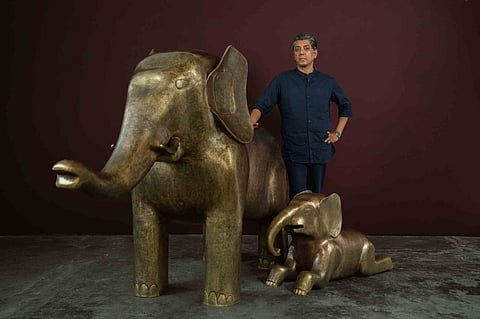

In the quiet gardens of L’Hôtel de Maisons, once the Parisian home of designer Karl Lagerfeld, something extraordinary took shape October-end.
Amid the rustle of leaves and the scent of hammered metal, ‘The Soul Garden’ by Vikram Goyal Studio invited visitors into a realm where myth, material, and memory converged. Presented by The Future Perfect for Design Miami/Paris 2025, the installation reinterpreted India’s over 2,000-year-old Panchatantra fables through an immersive dialogue of art, design, and ecology.
The Panchatantra had long fascinated Goyal not merely as a collection of moral tales, but as a framework for understanding human nature. “It’s a mirror,” he said, “using animals to reflect the complexities of our own behaviour, ambition, friendship, betrayal, wisdom.” In ‘The Soul Garden’, he moved from narration to experience, transforming allegory into atmosphere. Each sculptural form embodied an emotional state rather than a literal retelling: Kurma, the Tortoise, represented patience; Vyaghra, the Tiger, vigilance; Gaja and Karabha, the Elephants, strength and tenderness; and Nakra, the Crocodile, adaptability.
Working in metal allowed Goyal to express transformation and endurance, ideas at the heart of the fables. “Metal carries memory,” he explained. “Patinas, textures, and forms become the new language of fable.” Rather than directly illustrating stories, Goyal evoked their spirit through material and space. The challenge had been to preserve the moral depth and ambiguity that made these ancient tales timeless while giving them a sculptural language that felt utterly contemporary.
The art of the repoussé
Each work was handcrafted using repoussé, a centuries-old Indian technique of shaping metal from the reverse side to create relief, and a studio innovation known as hollowed joinery, which fused sheet metal to form sculptural volume. “Repoussé felt like meditation,” Goyal said. “It was a process of coaxing form rather than forcing it, revealing softness through strength.” Every curve and indentation carried the rhythm of the maker’s breath, turning the surface into narrative.
Hollowed joinery, by contrast, introduced lightness and inner stillness. Instead of casting metal in molds, the studio fused sheets together to create forms that felt both solid and weightless. “It was as though the space within the sculpture was as meaningful as its structure,” Goyal explained. The interplay between repoussé and hollowed joinery gave the animals both texture and presence, strength balanced with serenity, power tempered by grace.
A profound new dimension came through the collaboration with Berlin-based olfactory artist Sissel Tolaas. Known for her experimental work with scent as language, Tolaas worked with Goyal to weave a “language of air” through the installation. She captured molecules from the act of making, the heat of hammered metal, the burnished patina, the ambient studio air, and combined them with smells inspired by the animals’ natural habitats.
“Smell is the most instinctive form of communication,” said Goyal. “It can take us somewhere long forgotten in an instant.” Using both nanotechnological and analogue diffusion systems, Tolaas created an invisible choreography that connected the sculptures through air. As visitors moved through the garden, the scents shifted and mingled, binding material, memory, and mood. “Smell transformed space into emotion,” Goyal reflected. “It turned objects into organisms, making empathy and memory feel physically present.”
Each visitor to the exhibition was invited to become a “caretaker.” Upon entry, they received a small talisman, a symbolic gesture of guardianship. “In Indian philosophy, to care for something, a story, an animal, a craft, is to ensure its rebirth. Art could awaken empathy. It reminded us that ecology and heritage are not abstract ideas, but living systems we belong to,” he said.
The work’s demands
Each day at five o’clock, actors from Cours Florent, France’s renowned performing arts school, read Panchatantra fables within the installation. Their voices, mingling with scent and sculpture, turned The Soul Garden into a living ritual. “It became a performance of reflection,” Goyal said. “A moment to listen again to what these animals have always been telling us.”
For Goyal, patience, the virtue embodied by Kurma the Tortoise, was the guiding spirit of the project. “The making of these works demanded endurance from both the artisans and myself,” he admitted. “Patience is an act of faith, trusting the slow unfolding of form and allowing beauty to emerge at its own rhythm.” In a world obsessed with speed, ‘The Soul Garden’ reminded visitors of the value of stillness.
Presenting the work in Paris carried its own resonance. L’Hôtel de Maisons, a building layered with centuries of artistic history, offered a natural setting for this dialogue between cultures. “The building’s sense of continuity, of creation upon creation, was deeply symbolic,” said Goyal. “Bringing Indian mythology and craft into that space felt like a conversation between two traditions that both value refinement and storytelling.” He wanted the installation to feel as though it had always belonged there, merging with the architecture rather than competing with it.
There was also poetry in the setting: sacred Indian animal forms, crafted with ancient techniques, placed within a home once belonging to Lagerfeld, a figure synonymous with modern creativity and reinvention. “It felt like completing a circle,” Goyal reflected, “where heritage and modernity met on equal ground.”
‘The Soul Garden’ also marked a new direction for the studio, towards more interdisciplinary, multisensory work that engaged every sense and layer of consciousness. Collaborations with scent, literature, and performance expanded Goyal’s vision of what design could be. “It made me realise that the future of design lies in experience,” he said. “At its most powerful, design is not decoration. It is a way of connecting people to the timeless rhythms of nature and imagination.”