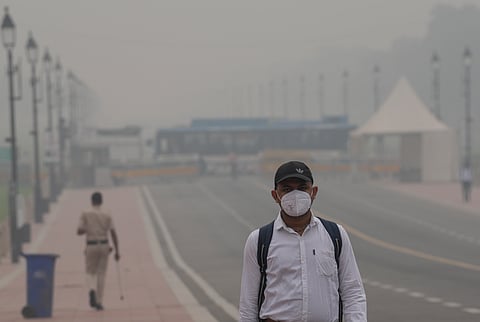

NEW DELHI: A dense veil of smog settled over the national capital on Thursday, as air pollutant levels climbed sharply and showed little sign of relief. The city’s AQI slipped back into the “very poor” bracket after a brief spell of relief earlier in the week, as stubble burning and calm wind conditions intensified pollution levels across the National Capital Region.
According to the Central Pollution Control Board (CPCB), the city recorded a 24-hour average Air Quality Index (AQI) of 311 at 4 pm, placing it in the “red zone.” This marked a sharp jump from Wednesday’s moderate 202 — a day when favourable wind speeds had temporarily improved dispersion of pollutants. The CPCB’s real-time data showed that Delhi ranked fourth among 254 cities with the worst air quality, while Rohtak topped the list with an AQI of 348.
The air quality in Delhi has been oscillating between “poor” and “very poor” since Diwali, with occasional dips into the “severe” range. Data from the CPCB’s Sameer app revealed that 32 out of 38 monitoring stations in the capital recorded “very poor” readings on Thursday, each crossing the 300 mark. PM2.5 remained the dominant pollutant.
Forecasting models attributed the renewed spike largely to the burning of crop residue in neighbouring states. The Decision Support System (DSS) for air quality prediction estimated that stubble burning contributed 21.5 per cent to Delhi’s PM2.5 concentration on Thursday, with projections indicating a further rise — 36.9 per cent on Friday and 32.4 per cent on Saturday. In contrast, the share of farm fires had stood at just 1.2 per cent on Wednesday.
Satellite imagery recorded 94 stubble-burning incidents in Punjab, 13 in Haryana and 74 in Uttar Pradesh on Wednesday. Transport emissions emerged as the second-largest contributor, estimated at 16.2 per cent on Thursday and likely to fluctuate between 11 and 12 per cent over the next two days.
Meanwhile, the Air Quality Early Warning System for Delhi predicted unfavourable meteorological conditions in the coming days, with wind speeds dropping below 10 kmph from the northwest direction during the evening and night hours. Reduced wind flow is expected to hinder pollutant dispersion, keeping the air stagnant and the AQI in the “very poor” range till November 8.
