
In one of his oil paintings on jute, A.A. Raiba sketches a busy day in a village. Women can be seen engaged in routine activities — collecting water, pounding spices. A bright pink house, with colourful doors and windows and a large elephant mural mainly dominates the scene. Bulls and bullock carts, a man resting at the doorstep, and shady trees are other features of the artwork — drawn with plenty of pink, red, ochre, green, and brown shades.
More such works by Raiba are on display at the exhibition, ‘A.A. Raiba: The Inner Contour’, at Travancore Palace in New Delhi. Organised by the Gallery Dotwalk, the show will be on view till November 10. It features Raiba’s early paintings, drawings, and glass works, spanning his journey as a student at Mumbai’s Sir J.J. School of Art and his later artworks inspired by travel and everyday life.
The exhibition has been curated by Sibdas Sengupta, a conceptual artist himself, under the guidance of art historian R. Siva Kumar.

About Raiba
Abdul Aziz Raiba was born in Bombay in 1922. He was among the early Indian modernists who sought to bridge tradition and modernity in their artworks. Raiba was influenced by Persian and Mughal miniature paintings and later came up with a distinct style consisting of bold outlines, shapes and figures.
His interest in calligraphy, which often requires control and precision, assured the quality of fine lines in his art.
Raiba studied at the Sir J. J. School of Art in Mumbai, between 1942 and 1946, also a period when the Indian artists were turning towards indigenous modernisms. He also went on to join the Progressive Artists' Group — a 1947 Indian art movement founded in Bombay (now Mumbai) by six artists (F.N. Souza, S.H. Raza, M.F. Husain, K.H. Ara, H.A. Gade, and S.K. Bakre). The group aimed to break free from colonial perspectives and move towards a redefinition of the Indian path – by drawing on Indian culture and synthesising it with Western styles of Expressionism, Cubism, and Surrealism. However, Raiba left the group later, and took off on his own journey.
Studying nature
Some of the sketches produced by Raiba in Jammu and Kashmir, especially in between 1957 to 1959, comprise drawings of almond blossoms near Akbar Fort in Srinagar, chinar trees on the way to Ganderbal, Kashmir’s mulberry trees in autumn, rivers flowing through rocky terrains, and others. The sketches appear raw though neatly drawn with charcoal on paper.
Raiba’s glass paintings have been created through a process of layering different textures under a glass frame. He paints women, adorned in jewels — standing near hooded jharokhas; birds perched on branches, sailing ships, and so on.
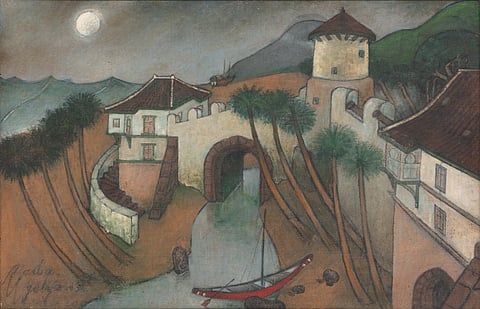
The jute paintings are textured, often depicting village scenes or green landscapes. In a similar painting, made out of oil paint on jute, the artist paints small, mud houses, tall palm trees, and wooden boats on the shore of a sandy beach. The water ripples have been formed out of quite thick, pale blue paint strokes, ripples and waves, and are hence, noticeable.
An 'unfinished' modernism
According to Sengupta, Raiba’s modernism remained “unfinished”, not because it lacked direction, but because it kept evolving with his experimentations.
“Raiba’s practice, I would say, represents an ‘unfinished modernism’,” Sengupta remarks. “By that, I mean his work doesn’t fit into the fixed boundaries of what we generally define as modernism—where artists, their objectives, and their visions are neatly identifiable. In Raiba’s case, the fascination lies in this sense of ‘unfinishedness,’ not as a negative, but as a deliberate openness to experimentation — with materials, techniques, and ideas.”
Raiba’s art, Sengupta stresses, isn’t “frozen or fossilised” within a specific timeline. It has continued to evolve. His work also “opens up opportunities to look at other artists of his time, those whose works may not have been widely seen or studied, yet who made remarkable contributions”. According to Sengupta, through these artworks, we are encouraged to rethink and expand our understanding of what modernism in Indian art could truly encompass.