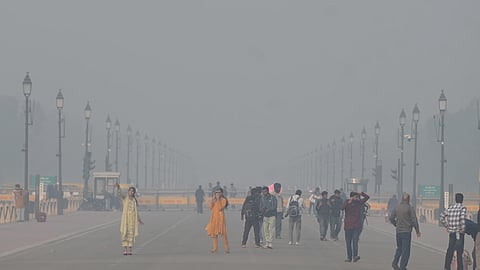

NEW DELHI: The national capital and its adjoining districts woke up to a thick blanket of smog on Tuesday as air quality plunged sharply into the “severe” category, prompting the Commission for Air Quality Management (CAQM) to enforce Stage-III of the Graded Response Action Plan (GRAP) across Delhi-NCR.
“The AQI of Delhi, which was recorded at 362 on November 10, showed a sharp increasing trend and reached 425 at 9 am on November 11 owing to calm winds, a stable atmosphere, and unfavourable meteorological conditions,” the CAQM said in a statement.
“Keeping in view the prevailing trend of air quality, and in an effort to prevent further deterioration in the region, the Sub-Committee has decided to invoke all actions under Stage-III of GRAP — ‘Severe’ Air Quality (Delhi AQI ranging between 401–450) — with immediate effect across the NCR,” it added.
Under the new restrictions, all non-essential construction and demolition activities across the region have been halted. This includes earthwork, piling, trenching, open-air operation of ready-mix concrete plants, and transport of building materials like sand and cement on unpaved roads. Only essential public projects — such as railways, metro, airports, defence, and healthcare facilities — are allowed to continue, provided they adhere to strict dust and waste management norms.
Vehicle restrictions have also been tightened, with BS-III petrol and BS-IV diesel four-wheelers barred from plying in Delhi and NCR districts, including Gurugram, Faridabad, Ghaziabad, and Gautam Buddh Nagar. Non-compliant inter-state buses and medium goods vehicles have also been prohibited unless they carry essential goods.
Doctors have warned that the air quality breaching the 400 mark poses a serious health threat. “Even healthy people can experience throat irritation, cough, and breathlessness, while those with asthma, COPD, or heart problems are at much greater risk,” said Dr. Ravi Shekhar Jha, Director and Unit Head, Pulmonology, Fortis Faridabad. He added that prolonged exposure to such pollution levels could cause lasting damage to the lungs and heart, calling it a “public health emergency.”
