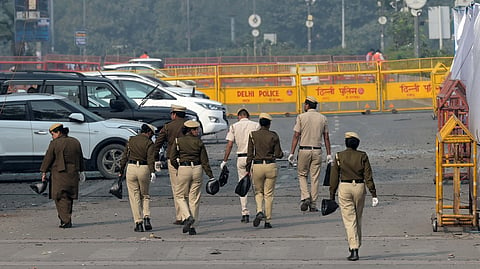

The blast at Chandni Chowk last week tore through the heart of old Delhi, however, for many of us who have lived in Delhi long enough, it wasn’t just another news headline. It was déja vu. A cold gust from the past. That evening, I was driving home, taking the Mahatma Gandhi Marg (Ring Road), parallel to Subhash Road, when my phone began to ring incessantly.
Within minutes of the explosion, family members were calling, their voices laced with fear, saying, “Are you safe?” The natural anxiety that follows every such incident in Delhi has become part of our daily grind.
This wasn’t the first time that phone calls, panic, and prayer filled Delhi’s air. I remember the 1980s, when I lived in the Kirori Mal College Hostel. Back then, the only way for worried parents to reach their children was the common hostel telephone. After every shootout or explosion, that phone would ring incessantly.
The 1980s were when Punjab militancy cast its first dark shadow over Delhi. The city changed overnight with sandbag bunkers appeared at intersections, police pickets sprouted like mushrooms, and iron pillboxes guarded key installations. Yet, the fear never really left. When gunfire became too risky for the militants, they turned to something far deadlier, using explosives.
Among their most terrifying innovations was the transistor bombs. One day, people discovered that some of bus passengers carried death inside transistors, leaving them behind. Unsuspecting co-passengers would switch them on to listen to a tune, and the next instant, there would be an explosion.
By the 1990s, the rhythm of Delhi’s life was punctuated by blasts. As a young reporter covering those incidents, I saw how quickly normalcy could collapse. One moment the markets (Chandni Chowk, Karol Bagh, Lajpat Nagar and Sarojini Nagar) buzzed with bargaining voices and the next, they were scenes of chaos, the twisted metal, shattered glass, sirens, and screams.
Even the city’s quieter corners were not spared. Explosions took place in localities that were then considered too peripheral to warrant high security. The terror networks seemed determined to remind Delhi that it was never too far away. However, each time, Delhi picked itself up, dusted the debris, and moved on. But the scars stayed.
Among the most audacious incidents was the blast outside the Delhi Police Headquarters near ITO, right across the road at the exit gate of the Central Revenue Building. We were in our office nearby on Bahadur Shah Zafar Marg when the floor shook violently. Running out, we found that a police beat box, meant to shelter a constable on duty, had been turned into a bomb.
The beat box, as it turned out, had been leased by a corrupt cop to a street vendor to store goods. Terrorists used that same space to plant their device. If ever there was a metaphor for how corruption feeds terror, this was it.
One name came to dominate the investigations of those years, Abdul Karim Tunda. A soft-spoken man from Pilkhuwa near Hapur in Western Uttar Pradesh, he had an expert’s knowledge of chemicals, Tunda was a master bomb-maker.
His ideological roots traced back to the Deoband seminary in Muzzafarnagar district, an institution often described as the ideological cradle for many who later turned to extremist paths. Ironically, that same seminary was in the news recently when India officially facilitated a visit there of the delegation of the Taliban government from Afghanistan.
The government framed it as a diplomatic outreach, but the gesture felt awkward, a meeting of extremes under the garb of engagement. Has such outreach softened the ideology of those who draw inspiration from radical theology? The explosions that followed in Delhi suggest otherwise. What the Chandni Chowk blast tells us is that terrorism never truly left Delhi. It merely adapted, morphing to survive new surveillance, new intelligence systems, and new political climates. The faces and names may change, but the underlying machinery, networks of recruitment, funding, and indoctrination remains disturbingly familiar.
Yes, Delhi today looks better protected than ever before. Cameras line the streets, police checkpoints dot every arterial road, and intelligence agencies track coded messages. But terrorism in our age no longer relies only on physical space, it thrives in the shadows of the internet and in the vulnerabilities of the disillusioned.