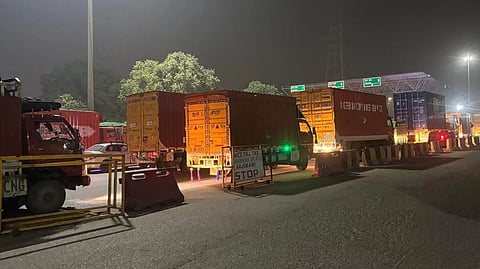

Four days after the Red Fort blast that shook the capital, claiming 13 lives, Delhi grapples to hold its borders tight. A detailed survey across several border points and major highways of the National Capital Region (NCR) undertaken by this newspaper reveals what can be rightly said to be a sordid state of affairs with a surprising gap in security preparedness.
Highways that should see adequate police presence at night had surprisingly thin deployment, questioning the capital’s response to threats. Routine deployment of security personnel and business-as-usual policing amid the heightened national security concern raise red flags about safety and preparedness.
The ‘could have beens’
Usually, after any incident involving explosives, intensified checking at all borders, an increase in PCR patrolling, deployment of Quick Reaction Teams, checks on highways, barricading and slow-lane diversions, mandatory checking of suspicious vehicles and increased coordination with police in adjoining districts should be in place. However, 100 hours after the terror attack, none of these measures were visible in the border entry points.
However, security arrangements at key entry points to Delhi remained almost the same as on any regular day – no visible additional barricades, no intensified checking, and barely any police presence, even though these corridors are the capital’s most vulnerable linkages to the neighbouring states.
The correspondents travelled nearly 150 to 200 kilometres across Delhi, Noida, Gurugram, Ghaziabad, Faridabad and Greater Noida throughout the night to assess whether the blast—which raised major questions on internal security—had triggered any increase in border surveillance or night-time patrolling.
However, only three Delhi Police PCR vans were spotted across the long stretch. Two PCR vans were seen between Badarpur and AIIMS, and one PCR van was seen near Dilshad Garden. Beyond these isolated patrols, the highways, borders, and arterial roads appeared bereft of visible law-enforcement presence.
At all major entry points surveyed—including the Badarpur, Apsara, Loni, Ghazipur, and Kalindi Kunj borders—the only personnel consistently visible were toll tax employees. These staff members were busy with routine toll collection and traffic management, but there was no sign of police checking or enhanced monitoring of incoming vehicles. This stood in contrast to what would be expected following a major security incident inside Delhi. Border roads that connect the city to Ghaziabad, Gautam Buddh Nagar (Noida, Greater Noida), Gurgaon, and Faridabad are usually the first to witness tightened checks after any threat alert or terror-linked event.
No checkpoints, no increase in barricades, no document checks or vehicle inspections. Deployment of additional PCRs, highway patrols, or Quick Reaction Teams was nowhere to be found.
At the Badarpur border, which links the capital to Faridabad and sees heavy movement even at odd hours, the situation appeared routine. Except for regular toll operations, the stretch had no police picket, no barricade expansion, and no visible officers monitoring vehicles entering Delhi. The vehicles flowed seamlessly into the city, just as they would on a normal day—surprising given that security agencies had earlier hinted at monitoring NCR border movements for suspicious activity.

All eyebrows raised
The i20 car that was involved in the blast near the Red Fort traced its route through the Badarpur border on Monday morning. The car was first spotted outside Asian Hospital in Faridabad at 7.30am, crossing the Badarpur toll at 8.13am to enter Delhi. It was seen near a petrol pump in Okhla Industrial Area before reaching the Red Fort parking lot at 3.19 pm. The car remained there for three hours before exploding at 6.52 pm.
The Apsara border near Dilshad Garden, one of the busiest gateways from Ghaziabad, replicated a similar scene. The area, which typically sees a good mix of passenger vehicles and commercial traffic, had no signs of intensified checking. The single PCR spotted in the area remained stationary, and there were no officers stopping vehicles for random inspection. The regular exercise of the toll tax collection was being conducted at the border.
At the Bhopura border, which accommodates heavy truck movement from Uttar Pradesh, the absence of increased policing was particularly notable. The stretch is often considered sensitive due to its high-density night-time truck traffic, yet it appeared unmanned from a security standpoint. The usual scene of vehicles paying toll tax and leaving or entering the capital was seen with no security checks.
The Ghazipur border, close to large wholesale markets and transport hubs, also had no special deployment. Similarly, Kalindi Kunj, which connects Delhi to Noida and has been used as an alternative route during past security emergencies, ran fully on toll staff.
Across all these points, no checkpoints, no route diversions, and no anti-sabotage activity were noticed.
The team also drove through several major highways cutting through the NCR—stretches that are vital entry conduits for lakhs of vehicles every day. These included Delhi–Meerut Road, Delhi–Gurugram Motorway, Delhi–Faridabad–Ballabhgarh corridor, Noida Motorway, NH-9 and NH-24 towards Ghaziabad, Mathura Road and Outer Ring Road and several connector highways.
Across these routes, the scenario remained unchanged—no extra barricades, no vehicle frisking, and no visible area domination by police.
Commuters expressed surprise that the aftermath of the blast had not translated into more visible policing. Many recalled instances in prior years when far smaller incidents led to immediate clampdowns, including traffic diversions and heavy barricading at border points.
Several motorists crossing the Badarpur and Ghazipur borders said they expected at least some questioning or checks, given the seriousness of the incident.
However, the police personnel at Chilla border near Mayur Vihar, which connects Delhi with Noida in Uttar Pradesh, claimed that the security checking has been increased and they are actively doing the routine checking, especially of the suspicious vehicles at the border. Several police barricades were also placed. Apart from this, the transport department personnel were also deployed for the checking.
The border is very crucial for the commuters who visit Agra, Mathura, or even Lucknow from Delhi, as they can reach Yamuna Motorway after crossing the Chilla border.
The Gurugram-Delhi border on National Highway 148A reflected the same casual approach – slipped back to routine movement. Peak-hour congestion had eased by the afternoon, and traffic continued to move steadily through the MCD toll plaza, which was operating as usual. Two layers of barricades placed on either side of the booth had been pulled back to keep the flow smooth, allowing vehicles to pass without any scrutiny.
Only a couple of police personnel were stationed at the spot, and they appeared disengaged, neither stopping vehicles nor monitoring movement closely. No surprise checks were being carried out.
Local vendors confirmed that the increased police presence seen immediately after the blast has since tapered off. Suresh, who runs a tea stall near the toll, said security had been noticeably stricter for a couple of days, with more personnel deployed and checking vehicles. “But things have slowly returned to normal now,” he said. “Lakhs of vehicles pass through every day. It would be impossible to check them all.”
Apart from this, authorities have intensified checks related to GRAP-III across all entry points into Delhi. Vehicles that fall under the prohibited categories are being stopped at the borders and turned back without exception, as the city has been witnessing a severe air quality index for the last couple of days, forcing authorities to implement the regulations under GRAP-III.
At the Gurugram–Delhi border, a toll booth employee said that they, along with police personnel, are conducting strict screening of every vehicle approaching the capital.
“Any vehicle that is not permitted under the GRAP-III restrictions or is not destined for Delhi is being immediately sent back. This includes BS-III diesel vehicles and trucks transporting construction material. So far, we have turned back nearly 70 to 80 vehicles, and this enforcement will continue as long as the restrictions remain in place. This is being implemented strictly,” he said.
There was a long queue of vehicles at the Delhi-Gurugram border, mostly trucks, which were waiting for their turn to enter the capital.
Meanwhile, Virender Kumar, a truck driver coming from Uttar Pradesh to Delhi, confirmed that security checks have been heightened on both sides of the border. “For the past several days, I’ve noticed that the checking in UP as well as in Delhi has increased significantly.
Police personnel are stopping and returning vehicles that are not allowed to enter the capital,” he said at the Apsara border. Another driver at the Badarpur border said, “I’m not completely aware of the current security measures because I haven’t travelled to Delhi since the incident. But considering what happened, I’m assuming that the checking has been strengthened.”
Difficulties on ground
Earlier this year, the Comptroller and Auditor General (CAG) report stated that there are 128 entry points from where vehicles can enter into Delhi. Out of these, 80% of the commercial vehicles enter Delhi from 13 entry points. The report, however, observed that enforcement teams were being deployed at only seven entry points.
Besides the shortage of staff, the enforcement teams did not have vehicles mounted with PUC equipment to check visible polluting vehicles. This resulted in adequate coverage of entry points to Delhi, ultimately indicating a weak enforcement regime. In the absence of input data regarding location-wise vehicular load, deployment of the few ill-equipped enforcement teams was also bound to be sub-optimal.
The enforcement branch was working with 292 personnel against a sanctioned strength of 819 as of January 2021. The sanctioned strength of 819 was fixed in 2008, when the number of registered vehicles in Delhi was around 51 lakhs, vis-a w-vis around 130 lakh vehicles registered as of March 2021.
Despite an acute shortage of staff, 43 personnel of the enforcement branch, including 6 inspectors, 9 sub-inspectors, 13 assistant sub-inspectors and 15 head constables, have been deployed to other branches/wings of DoT. Thus, the enforcement wing had a significant shortage of manpower.
DoT had assessed the (January 2020) requirement of 1134 additional posts to be able to deploy enforcement teams at 25 major entry points and 33 locations within Delhi round the clock. DoT stated (September 2021) the matter to be under process. While admitting that there was a shortage of manpower in the enforcement branch, DoT replied (November 2021) that 56 teams had been deployed at various parts of Delhi.
Terror nets and probe updates
The probe into a possible terror module began when JeM posters were found at Bunpora, Nowgam. The protesters threatened police and security personnel for working with the government. Investigative agencies zeroed in on the Faridabad module.
During the investigation, the Faridabad Police seized two vehicles--a red Ford EcoSport car from Khandawali village and the other suspicious Brezza car parked at Al Falah University in Dhauj, Faridabad, believed to be connected to the Red Fort blast incident. A DNA analysis had confirmed that Dr Umar Nabi, a Pulwama-born medical professional, was behind the wheel of the i20 car. The forensic experts matched DNA samples collected from the blast site with those of Umar’s mother, confirming his identity. As the city recovers from the incident, more angles are being probed by the authorities.