
For over two decades, the Public Service Broadcasting Trust (PSBT) has quietly shaped India’s documentary film ecosystem. Founded in 2000 through a partnership between Prasar Bharati, the Ford Foundation, and independent creators, it has grown into a rare non-profit platform that consistently empowers independent voices.
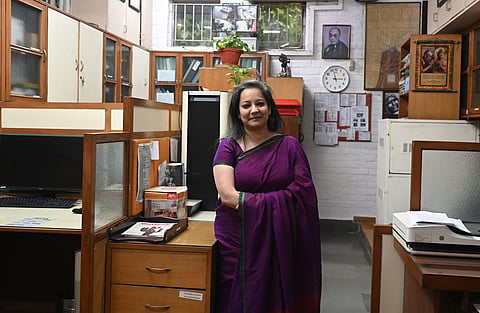
This year, as the organisation marks 25 years, filmmaker Aparna Sanyal steps into the role of Director — returning to a space that has shaped her own path. With more than 25 years in media and filmmaking behind her, Sanyal’s journey to this leadership role, she says, began in 2020, amid the disorientation of the pandemic.
At that time, PSBT itself was in transition — two decades old, reflective, uncertain about the direction to take. Filmmakers were moving away from traditional news pegs, towards more artistic and personal narratives, with environmental issues, social change, and intimate stories at the forefront. Documentaries were no more just straight reportages but more immersive.

“It was an inflection point,” Sanyal recalls. In response, Managing Trustee Rajiv Mehrotra launched the PSBT Online Film Challenge, imagining a way to reach filmmakers during lockdown. It was then that Sanyal stepped in as its executive director.
Building from scratch
Nearly 800 films poured in from all over the country — such as Akshay Ingle’s Mahalle’s School, Bijoy Chowdhury’s Undivided Solitude, and Chasing the Light by Harmeet Basur. “We created quite an interesting matrix of films that we wanted to look at and we also put together a very good screening committee and a great jury,” adds Sanyal. The success of the challenge encouraged deeper conversations within PSBT, about the broader nonfiction ecosystem and what young filmmakers needed.
From these discussions emerged DocCommune, PSBT’s flagship mentoring programme in 2021. “We wanted not just mentorship, but a community,” says Sanyal. “A space where young filmmakers could meet and support each other, and stay invested in each other’s work.” Four years later, DocCommune has become one of the country’s only free mentorship programmes that also leads to potential grants.
With over 75 festival selections, multiple awards, and a growing body of short documentaries, Sanyal sees its impact as proof of something simple – freedom. “That’s been PSBT’s core for 25 years. Our aspiration is for filmmakers to make the films they truly want to make,” she says.
This year, Bali (2025) by Amoli Birewar won a DokuKids Special Mention at the 9th DokuBaku International Documentary Film Festival in Baku, Azerbaijan. The film follows Sujata, a young woman from a Maharashtrian village who dreams of becoming a kabaddi player but is steered toward a forced marriage. Another standout is Divya Kharnare’s P for Paparazzi (2024), screened at IFFI Goa 2024, and the International Documentary & Short Film Festival of Kerala 2024, where it won Best Editing. The film dives into the world of Indian paparazzi through Manoj Stillwala, a Nepalese photographer, revealing the tough economic realities that drive their work beyond the chase for celebrity moments.
Leadership in transition
For Sanyal, the role comes with the weight and gift of working closely with Mehrotra, whose vision has guided PSBT since its inception in 2000. She says generosity is the biggest thing she has learned from him. “He has always believed in giving people the space to tell their stories. He’s always willing to open the door a little wider for voices from different places and identities.”
As she steps into formal leadership, the dialogue between their perspectives continues — his as the institution-builder, hers as the filmmaker. “He gives me space, but he also advises caution,” she says, laughing. “It’s a good balance.”
Now, as a younger leader steering PSBT forward, she brings her own sensibilities: experimentation, curiosity, and a commitment to staying relevant. “Change is inevitable in life. Mr Mehrotra and I talk about that constantly. Our job is to go with the times and understand what the ecosystem needs.”
Her leadership style is shaped by an instinctive comfort with change. Sanyal has moved through careers with a kind of instinctive agility — from economics to television, from CNN’s newsroom during 9/11 to Jamia’s film school, from freelancing to founding her own production house in 2011. “I know when I need to leave,” she says. “If I’m not learning, I feel the need to move on.” This drive — which she jokes aligns with Indian philosophy's neti, neti, “not this, not that” — has shaped her filmmaking, her entrepreneurial life, and now her approach to running PSBT.
Shaping vision
PSBT has long supported women filmmakers, with nearly half its films coming from women. In her new role, Sanyal hopes to extend that openness to filmmakers across identities and geographies. “We shouldn’t be obsessed with one identity. Every filmmaker carries their own marginalities that come from their own particular locations in society, and of course, that inevitably influences their cinematic journeys. We want to see them express that in ways that seem most authentic to them. And, equally importantly, we also want to meet them where they are, and not overly influence their filmmaking vision,” she says.
When asked about balancing freedom with responsibility — especially when films explore sensitive themes — she pushes back against the notion of documentaries as rigid vessels of truth. “A documentary isn’t a single truth-telling machine,” she says. “Truth is multi-hued. A film is one version of it.”
Under Sanyal, PSBT remains committed to socially relevant, artistically rigorous work — but with newer, bolder explorations. She hints at conversations with OTT platforms. “OTT content has become predictable,” she says with a small laugh. “Our young filmmakers can be a breath of fresh air. They are unapologetic about who they are.”
For Sanyal, the challenges facing Indian documentaries — especially distribution and the absence of a robust market — can’t be solved by one organisation alone. “We need the whole ecosystem,” she says. She hopes to build bridges with filmmakers, labs, and development programmes across the country. “I believe in collaboration, not competition. If we come together, we can create something far more exciting.”
Despite the structural challenges and institutional responsibilities ahead of her, Sanyal remains, at her core, the filmmaker who is driven by ideas. “I just want to facilitate,” she says. “Enable filmmakers. Create spaces where stories can flourish. If I can help more voices find their way into the world, that feels meaningful. And meaning — that’s what I follow.”