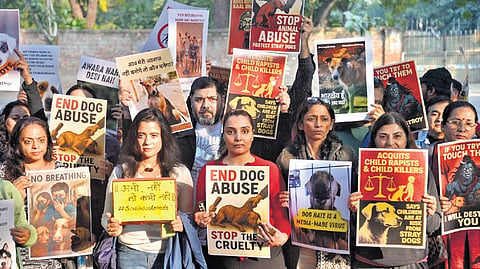

NEW DELHI: Days after the Supreme Court directed all States and Union Territories to remove stray dogs from educational institutions, hospitals, sports complexes, bus stands and railway stations, and relocate them “to a designated shelter” after due sterilisation and vaccination, many of these spaces have witnessed a visible drop in dog numbers, say activists and caregivers.
They have also alleged that dogs are being picked up arbitrarily from several areas in the capital. However, where these dogs have been taken remains unclear especially given the lack of adequate animal shelters in the capital.
According to the August 22 SC’s order, animal welfare petitioners told the court that “the municipal authorities have already started rounding up the stray dogs” and that “almost 700 stray dogs have already been picked up, and there is no information as to the fate of the said stray dogs. They (animal welfare groups) apprehend that a large population of stray dogs, which might also include newborn puppies, is likely to be affected and may lose their lives if the directions given by this Court are not stayed.”
Speaking to the newspaper, Delhi-NCR–based animal activist Manavi Rai said, “Delhi does not have a single functioning government shelter for stray dogs.” She added that while the city has around 20 Animal Birth Control (ABC) centres with temporary holding facilities for dogs after sterilisation, no permanent shelters exist. “Around `13–15 crore are given every year for sterilisation and vaccination of dogs, but till date no one has found out how the population is increasing,” Rai further said.
Media reports recently highlighted that the MCD’s standing committee deferred a proposal to allocate `13.5 crore to the veterinary department for clearing pending payments to NGOs engaged in dog sterilisation and vaccination. The reports also noted that none of the 13 NGOs running the 20 sterilisation centres have been paid since March. Standing committee members have claimed that the performance of many NGOs has not been satisfactory, adding that a committee has been formed to address the dog menace.
On the other hand, Ayesha Christina Benn, Founder of Neighbourhood Woof—an MCD-empanelled animal shelter—said their dues worth `52 lakh for 21 months were not cleared in 2022, forcing them to temporarily shut operations. She added that since 2023, the corporation has updated its ‘project recognition’ rules for centres. But delays in payments meant, “we had to raise funds in order to reconstruct the centre as per the updated rules.” She further said, “Animal Welfare Board must conduct inspections on a time-bound basis to give recognition to these centres so that they can function effectively and smoothly.”
The Supreme Court order further stated, “Each individual dog lover and each NGO that has approached this Court shall deposit a sum of `25,000 and `2,00,000, respectively, with the Registry. The amounts so deposited shall be utilised in the creation of the infrastructure and facilities for the stray dogs under the aegis of the respective municipal bodies.”
Reacting to this, Ambika Shukla, Trustee, Sanjay Gandhi Animal Care Centre, said, “If this money is claimed to go for infrastructure of the animals—which is primarily the municipal corporation’s responsibility—then the parties who are making the payments should also receive a utilisation report.” She added that the Supreme Court has mandated that the dogs be moved to a designated shelter. “And there is no designated shelter; they cannot take the dogs to an ABC unit instead.”
An advocate representing animal welfare groups, who requested anonymity, alleged that “the November 7 order was passed without hearing our side. Around 50–60 lawyers were present in court and none were allowed to speak.”
